
Designed to Lose
How Sophisticated Political Operations Use Failed Legislation as Strategic Infrastructure

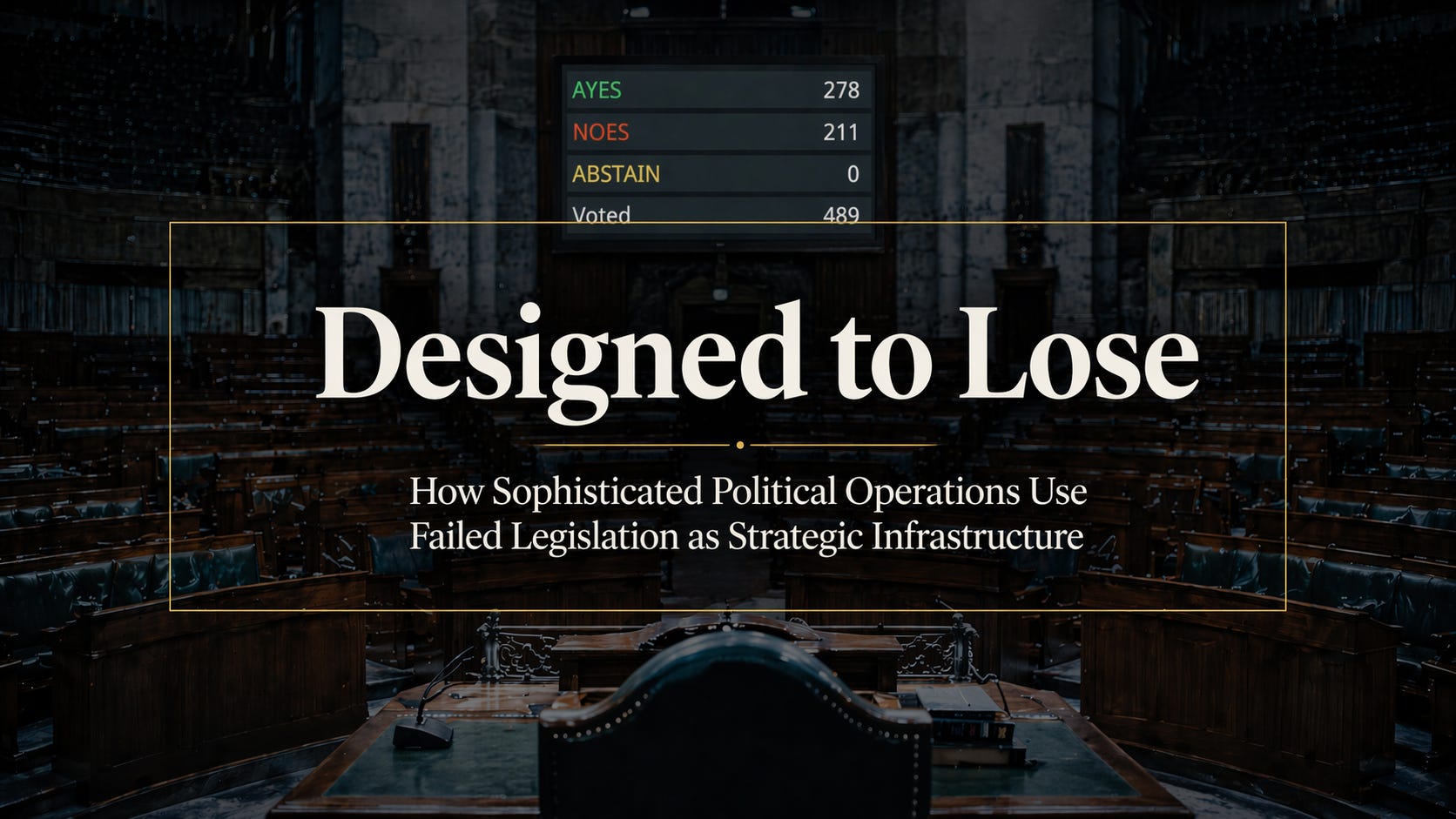
In any advanced democracy, the legislation that fails on the floor is often more valuable to the ruling party than the legislation that passes. The vote is not the objective. The vote is the vehicle.
On April 18, 2026, India’s ruling National Democratic Alliance introduced a constitutional amendment it knew it could not pass.
The 131st Amendment Bill required a two-thirds supermajority of members present and voting in the Lok Sabha. With 528 members present, the threshold was 352 votes.
The NDA coalition commanded approximately 293 seats. The bill was 59 votes short before debate opened. It failed as scheduled. 298 in favour. 230 against. The Delimitation Bill and the Union Territories Laws Amendment Bill, both dependent on the constitutional amendment, were withdrawn.
The opposition celebrated. Editorial pages declared a victory for federal balance. Commentators treated the defeat as a setback for the ruling coalition.
Almost every significant interpretation of the outcome was wrong. The bill was not designed to pass. It was designed to fail in specific, usable ways.
This is a case study in how modern political operations use the legislative instrument itself as a weapon, whether or not the legislation ever becomes law.
The core principle:
In sophisticated political systems, what the bill does on the floor matters less than what the bill does to the terrain. This is not an Indian phenomenon. It is a universal technique in advanced democracies. The Indian case is simply the clearest recent demonstration.
The Arithmetic Problem Was Not a Problem
Any competent legislative whip running the numbers on April 15, 2026 could see that the 131st Amendment would fail.
The ruling coalition’s floor count was public information. Opposition whip positions had been signaled for weeks. The two-thirds threshold is not ambiguous. It is a fixed number. The decision to schedule the vote anyway tells you almost everything you need to know about the intent behind the bill. When a ruling party schedules a vote it knows it will lose, the loss is the product being manufactured.
Five operational reasons explain why a sophisticated political operation would deliberately manufacture a legislative defeat. Each one, independently, would justify the exercise. The five together produce returns that significantly exceed the cost of the failed vote.
Reason One: The Legitimation Trap
The 131st Amendment combined three distinct policy instruments into a single constitutional package:
Expansion of the lower house from 543 to 850 seats. Removal of the 1971 census basis for seat allocation. Operational activation of the 2023 Women’s Reservation Act.
The first two instruments were politically contestable. The third was not.
Women’s reservation carries near-universal public support across partisan, regional, and demographic lines in contemporary India. The original 2023 Act passed with cross-party consensus. Opposition parties had pushed for its faster implementation for years.
By binding the three instruments into a single vote, the ruling coalition constructed a structural trap.
Vote yes: accept the delimitation architecture that proportionally weakens opposition-governed states. Vote no: become the party that blocked the implementation of women’s reservation.
Neither option was costless for the opposition.
This is a technique with an established name in comparative political science: composite bundling. The mechanism binds a controversial provision to a popular one such that opposition to either looks like opposition to both.
The United States has used it repeatedly through the omnibus appropriations process, attaching contested policy riders to must-pass government funding bills. The European Union has used it in cross-directive negotiations, bundling member state concessions with broadly supported reforms. The United Kingdom used it in the 2019 Brexit withdrawal agreement debates, combining procedural and substantive provisions in single up or down votes.
Composite bundling is legal. It is standard parliamentary procedure. It is also one of the most effective tools available for forcing opposing coalitions into defensive posture.
The Home Minister’s post-vote statement, “Women of India will not forgive you,” was not rhetoric produced in the heat of debate.
It was campaign infrastructure produced on schedule.
A factual note is necessary here because the legitimation trap depends on its being misunderstood. The Nari Shakti Vandan Adhiniyam, the original Women's Reservation Act, was passed unanimously by all parties in September 2023. Every party, including every opposition party, voted for it. It was notified into law on April 16, 2026. Women's reservation is already the law of India. What the 131st Amendment proposed was not the passage of women's reservation but the linking of its implementation to a delimitation exercise based on 15-year-old census data and a Lok Sabha expansion to 850 seats. The opposition did not vote against women's reservation. It voted against an amendment that attached women's reservation to a redistricting architecture. The legitimation trap works precisely because the public conflates the two. Every statement framed as 'the opposition blocked women's reservation' is factually incorrect. What the opposition blocked was the vehicle. The law it was attached to was already passed, already signed, and already in force. The trap's effectiveness is proportional to the public's failure to understand this distinction."
The grievance narrative is now embedded in national political discourse. Every subsequent opposition argument against delimitation can be framed, in ruling-coalition communication, as opposition to women’s representation.
That frame is now operational. Building it cost one scheduled legislative defeat.
Reason Two: The Anchoring Effect
Behavioral economics provides the technical term for what the 131st Amendment accomplished regardless of whether it passed: anchoring.
When an extreme opening position enters public discourse, it resets the range of proposals that subsequent negotiation treats as reasonable.
Before April 2026, the operational ceiling of Indian delimitation discussion was the existing 543-seat Lok Sabha expanded modestly, based on a future post-2026 census, with proportional protections for population-controlled states.
After April 2026, the new discourse baseline is 850 seats, 2011 census basis, and commission controlled delimitation.
Any future proposal that offers 750 seats, or 800 seats, or a hybrid census formula, now appears in public discourse as compromise rather than maximalism.
This effect is well-documented across negotiation theory, legislative bargaining models, and comparative constitutional politics. The Harvard Negotiation Project literature describes it as “first-offer anchoring.” Daniel Kahneman’s foundational work on cognitive bias identifies it as one of the most reliable and hardest-to-neutralise effects in adversarial decision-making.
Political operations that understand this effect use it systematically.
The United States 1994 Republican Contract with America anchored subsequent welfare reform debates around positions that had been politically marginal two years earlier. The 2010 Tea Party fiscal proposals anchored the 2011 debt ceiling negotiations around spending cuts that would have been unthinkable in 2009. The French Front National’s repeated immigration proposals through the 2010s anchored mainstream French political discourse around restrictions that had been outside the Overton window a decade before.
The pattern is consistent. Extreme opening positions that fail on their own terms still succeed in shifting the subsequent range of acceptable proposals.
Failed legislation is not failed positioning. It is often the most efficient form of positioning available.
Reason Three: Coalition Discipline Diagnostics
The third return on a scheduled legislative defeat is rarely discussed in public analysis because its value is strictly internal to the governing coalition.
The vote on April 18, 2026 produced detailed data on the loyalty patterns of every NDA component party under maximum opposition pressure.
Every absence was recorded. Every defection was recorded. Every reluctant vote, every last-minute commitment, every member who needed individual persuasion became a documented data point in the coalition’s internal accounting.
This is operationally more valuable than discipline data from a vote that was certain to pass.
A vote that passes easily tells you nothing about where your coalition breaks. A vote that fails under sustained opposition pressure reveals the exact location of every fracture in your own base.
That data shapes:
Seat-sharing negotiations for upcoming state elections. Cabinet portfolio allocation. Legislative sequencing for the remainder of the parliamentary term. Intelligence positions on which coalition partners are vulnerable to opposition recruitment.
Every major democratic political party runs this diagnostic regularly. The United States Republican Party used the 2017 Affordable Care Act repeal votes to map internal dissent within its own caucus, information that shaped subsequent leadership and committee decisions for years. The British Conservative Party used multiple Brexit withdrawal votes in 2019 as coalition mapping exercises, producing internal data that ultimately restructured the parliamentary party.
The 131st Amendment vote gave the NDA high-resolution coalition mapping at the cost of a single pre-committed legislative defeat.
The intelligence value persists for the remainder of the term.
Reason Four: Campaign Infrastructure for the Next Cycle
India’s next general election occurs in 2029.
Every major election is preceded by eighteen to twenty-four months of narrative infrastructure construction. The 131st Amendment vote initiated that construction cycle.
The ruling coalition now possesses, in documented legislative record, a grievance narrative deployable in every state the bill was designed to benefit:
“The opposition blocked your representation.” “The opposition blocked women’s reservation.” “The opposition is the reason your voice does not count.”
In Uttar Pradesh, Bihar, Madhya Pradesh, and Rajasthan, where the proposed expansion would have produced the largest absolute gains, this narrative has direct electoral utility.
The opposition, by voting against the bill, provided the raw material for its own political attack. It could not have done otherwise, given the actual consequences of the delimitation architecture.
But the campaign surface was designed into the vote.
This is a technique political operations describe as “provocation casting”: engineering a scenario where the opposition’s structurally correct response becomes campaign ammunition against them.
The 131st Amendment vote produced approximately three years of deployable campaign material in exchange for one scheduled defeat.
By standard political-operations return-on-investment metrics, this is an extraordinarily efficient exchange.
Reason Five: The Upper Chamber Problem
The fifth strategic return addresses a structural constraint that the ruling coalition has faced since 2014.
The Modi government has maintained reliable majorities in the Lok Sabha while consistently struggling for majorities in the Rajya Sabha.
This is a persistent problem in any parliamentary system where the two chambers have different selection mechanisms. The lower chamber reflects current electoral coalitions. The upper chamber reflects prior cycles of state-level outcomes. The two can diverge for extended periods, producing what political scientists call asymmetric bicameral friction.
The 131st Amendment’s proposed shift of the Lok Sabha to Rajya Sabha ratio from 2.2:1 to 3.3:1 would have addressed this structural problem directly.
In joint sittings of the two chambers, an expanded Lok Sabha dominates the combined vote mathematically. In the election of the President and Vice-President, which combines the weighted votes of both chambers and all state legislatures, the relative weight of the lower chamber increases.
This is a long-term structural advantage for any ruling coalition that controls the lower house more reliably than the upper. Even a failed attempt to operationalise this shift accomplishes two things. It places the proposal on the public legislative record, making it available for reintroduction.
It signals to the political system that the ruling coalition has identified asymmetric bicameral friction as a structural target.
Both signals persist regardless of the immediate vote outcome.
The Historical Catastrophic Success
There is, however, a serious counter-pattern in the comparative record running this play must account for.
The historical record on efficient gerrymanders contains two distinct outcomes. The first outcome is durable minority rule: Hungary since 2011, Malaysia from 1974 to 2018, the American South under single-party Democratic rule from 1877 to 1960.
The second outcome is catastrophic inversion.
In 1977, Ireland’s Fianna Fáil party redrew constituency boundaries so aggressively against Fine Gael that efficiency analysis projected Fianna Fáil dominance for a decade.
The very next election, that same year, Fianna Fáil lost 16 seats and control of the government in a wave election the map had made more catastrophic, not less.
The map’s efficiency had minimised the ruling party’s safe margins across every district simultaneously. When the electoral wave came, the minimised margins flipped en masse rather than absorbing the shift.
The same dynamic produced the American congressional inversions of 1872 and 1894. In both cases, aggressive redistricting had optimised seat-count returns by reducing margins in every district the ruling party held.
In both cases, the optimisation produced catastrophic collapse in a single election cycle because the efficiency model had traded structural protection for seat-count maximisation.
This is the paradox of the efficient gerrymander:
The more efficient the map, the more fragile it becomes.
A ruling party that distributes its supporters thinly across the maximum number of winnable districts has, by definition, minimised its margin in each one. A five-point shift in vote share that would cost a normally-distributed party a handful of seats costs an efficiency-optimised party a catastrophic cascade.
India’s 2024 general election produced a result relevant to this analysis.
The BJP won 240 Lok Sabha seats on a reduced vote share, down from 303 in 2019. This is the baseline against which any future redrawn map must be evaluated.
A map optimised for 2019 BJP vote shares would have absorbed the 2024 shift with reasonable margins.
A map optimised for 2024 conditions, with margins already compressed by lower baseline performance, would be structurally vulnerable to exactly the kind of cross-regional wave that produced the Irish 1977 inversion and the American Democratic collapses of 1872 and 1894.
The efficient gerrymander is a high-variance strategy. It produces decades of dominance when it works. It produces catastrophic single-cycle collapse when it fails.
Political operations that deploy it must accept the asymmetric risk profile.
Five Structural Predictions
The comparative record on failed consolidation attempts produces five predictions for the Indian case.
These are not speculations. They are structural extrapolations from documented patterns in Hungarian, Malaysian, American, and Turkish political operations.
One. Reintroduction within 24 months. Failed maximalist bills in parliamentary systems are typically reintroduced in modified form within one to two years, incorporating the procedural objections raised in the initial debate while preserving the core architectural intent. The most probable timeline places the next delimitation package between late 2027 and the 2028 budget session.
Two. Women’s reservation as 2029 campaign centrepiece. The legitimation frame constructed in April 2026 will be activated throughout the 2028 and 2029 campaign cycles. Opposition cooperation with future delimitation proposals will be framed as the price of women’s representation, placing the opposition in recurring defensive posture on an issue where it cannot construct effective counter-narrative.
Three. Basic structure doctrine challenge. One or more state governments from the affected southern bloc will formally challenge the constitutional validity of any delimitation that reduces their proportional representation, invoking the basic structure doctrine established in Kesavananda Bharati v. State of Kerala (1973). The resulting litigation will extend the timeline and add constitutional risk to the ruling coalition’s operational plan.
Four. Fiscal federalism becomes the secondary battlefield. Finance Commission negotiations for the 2031-2036 period will be renegotiated under anticipation of the parliamentary rebalancing. Southern states will attempt to front-load redistributive protections before their parliamentary leverage is reduced. This will produce the most contested Finance Commission cycle since the formation of the modern Indian fiscal architecture.
Five. Federal fracture as outer boundary scenario. Sustained structural disadvantage to revenue-contributing states has, in comparable federal systems, produced formal challenges to the federal compact itself. Spain’s ongoing Catalan crisis, Canada’s historical Quebec debates, and Nepal’s 2015 constitutional restructuring all followed extended periods of perceived fiscal and political imbalance between contributing regions and central governments. This outcome is not imminent in the Indian case. It is the outer boundary of the pattern’s consequences if the mechanism is operationalised without proportionality protection.
What Sophisticated Political Analysis Actually Requires
The April 18, 2026 vote was widely reported as a legislative defeat for the ruling coalition. By any serious measure of political operations analysis, it was not. It was a successfully executed legislative positioning exercise that happened to take the procedural form of a defeat.
The bill produced:
A legitimation frame for subsequent attempts. An anchoring effect that shifts the range of future negotiation. Detailed coalition discipline diagnostics. Approximately three years of campaign infrastructure. A public-record proposal for asymmetric bicameral adjustment.
All five returns persist beyond the vote itself. All five were the actual operational objectives. The vote was the delivery mechanism.
This is how advanced political operations in consolidated democracies deploy the legislative instrument.
Understanding this is not the same as endorsing it. It is the baseline analytical requirement for participating seriously in the politics of any modern democracy.
A voter, a journalist, or an opposition strategist who evaluates legislation exclusively by whether it passes is operating on an analytical framework that the opposing political operation has already superseded.
In sophisticated political systems, the vote is not the objective. The vote is the vehicle. The objective is what the vote does to the terrain on which the next vote will be fought.
India came within 54 votes of enacting the largest single redistricting exercise in the history of democratic government.
The bill failed. The mechanism did not.
The mechanism is now embedded in national political discourse, institutional memory, and the strategic planning of every serious political operation in the country.
This is not new. It repeats.
The only variable is whether the public, the press, and the opposition understand what was actually delivered on April 18, 2026.
For the record. The Nari Shakti Vandan Adhiniyam is the law. It was passed unanimously. It was notified on April 16, 2026. Any political communication, editorial analysis, or campaign narrative that describes the April 18 vote as a defeat of women's reservation is either uninformed or deliberately reinforcing the legitimation frame this article has described. The 131st Amendment was a separate constitutional instrument. It was the vehicle, not the cargo. The cargo is law. The vehicle was stopped. Confusing the two is not an analytical error. It is the mechanism working as designed."
The scorecard said defeat. The scoreboard said something else.