
Epstein Didn’t Build the Machine. He Found It Already Running and Used It for Something Worse.
The loop does not choose what it launders. Lockheed Martin used it for arms policy. Epstein used it for eugenics. The academic credibility was the same.

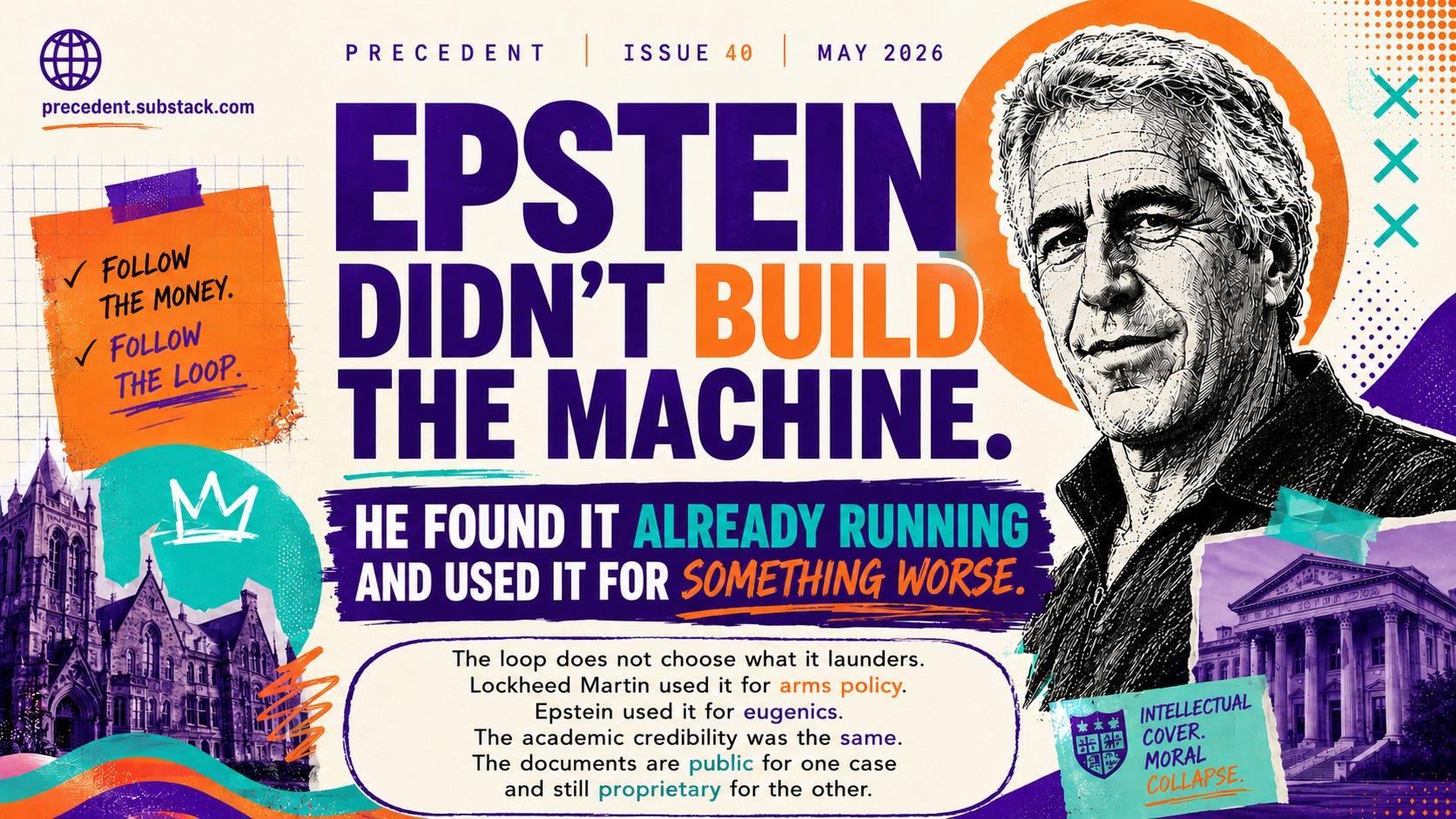
The Expert Laundering Loop does not choose what it launders. Lockheed Martin used it for arms policy. Jeffrey Epstein used it for eugenics. The academic credibility was the same in both cases. The documents are public for one of them and still proprietary for the other.
Power and Institutions · Issue 40 · PRECEDENT
Jeffrey Epstein funded approximately seventy-four percent of the Edge Foundation’s total budget, $638,000 of $857,000 in annual revenue, making him the dominant financial patron of the intellectual salon that connected him to Steven Pinker, Richard Dawkins, Daniel Kahneman, Marvin Minsky, Noam Chomsky, and the emerging generation of Silicon Valley billionaires who attended the Billionaires’ Dinners. Edge Foundation president John Brockman appears in 3,300 documents in the Justice Department file releases. He served as Epstein’s intellectual gatekeeper, and his literary clients were the scholars whose Ivy League credibility laundered Epstein’s presence at the same tables.
Between 1998 and 2008, Harvard University received $9.1 million from Epstein, including $6.5 million in 2003 to establish the Program for Evolutionary Dynamics under Professor Martin Nowak, a program that granted Epstein an office at Harvard, a formal platform to address academic audiences as though a scholar, and the institutional address of the world’s most recognisable research university. After Harvard President Drew Faust prohibited direct donations in 2008 following Epstein’s child-sex conviction, Epstein facilitated a further $9 million to Harvard through associates including Leon Black, with the knowledge and active assistance of Harvard development staff. Lawrence Summers, former United States Treasury Secretary and Harvard president, maintained contact with Epstein until the day before Epstein’s 2019 arrest. In February 2026, Summers resigned from all academic and faculty roles at Harvard. In December 2025, he was banned for life from the American Economic Association.
The AI researchers funded through this network, including Joscha Bach, who received more than one million dollars from Epstein and held office access at Harvard’s Program for Evolutionary Dynamics from 2014 to 2019, have carried the intellectual frameworks shaped inside that network into the companies, conferences, and technical cultures that now govern artificial intelligence development. The machine that Epstein built with Harvard’s address is not a closed chapter. It is a foundation layer.
The Expert Laundering Loop does not choose what it launders.
Issue 13 of this publication documented the loop using the defence think tank case: how $34.7 million in contractor funding distributed across fifty institutions produced a landscape of credentialed independent expert opinion that correlates with the distribution of that funding. The Epstein case is the same three phases used for a different purpose, operated at a different scale, and documented in forensic detail only because federal investigators produced the evidence that the loop normally keeps invisible.
This article names what the Epstein case adds to the mechanism that the defence think tank case could not show. The Expert Laundering Loop launders an agenda into credentialed consensus. There is a second mechanism that the Epstein network deployed alongside it: the deliberate elimination of the intellectual tradition that would produce the framework to contest that consensus. That mechanism has a name. The name is Epistemic Enclosure.
🎯 What this article gives you
By the end of this, you will know:
→ Why the Expert Laundering Loop documented in Issue 38 is the same mechanism that ran through Edge Foundation, Harvard’s Program for Evolutionary Dynamics, and the MIT Media Lab, with Epstein as the dominant financial patron of the entire architecture
→ What Epistemic Enclosure is, how it operates as a second mechanism alongside the loop, and why the deliberate suppression of the humanities was not incidental to Epstein’s project but constitutive of it
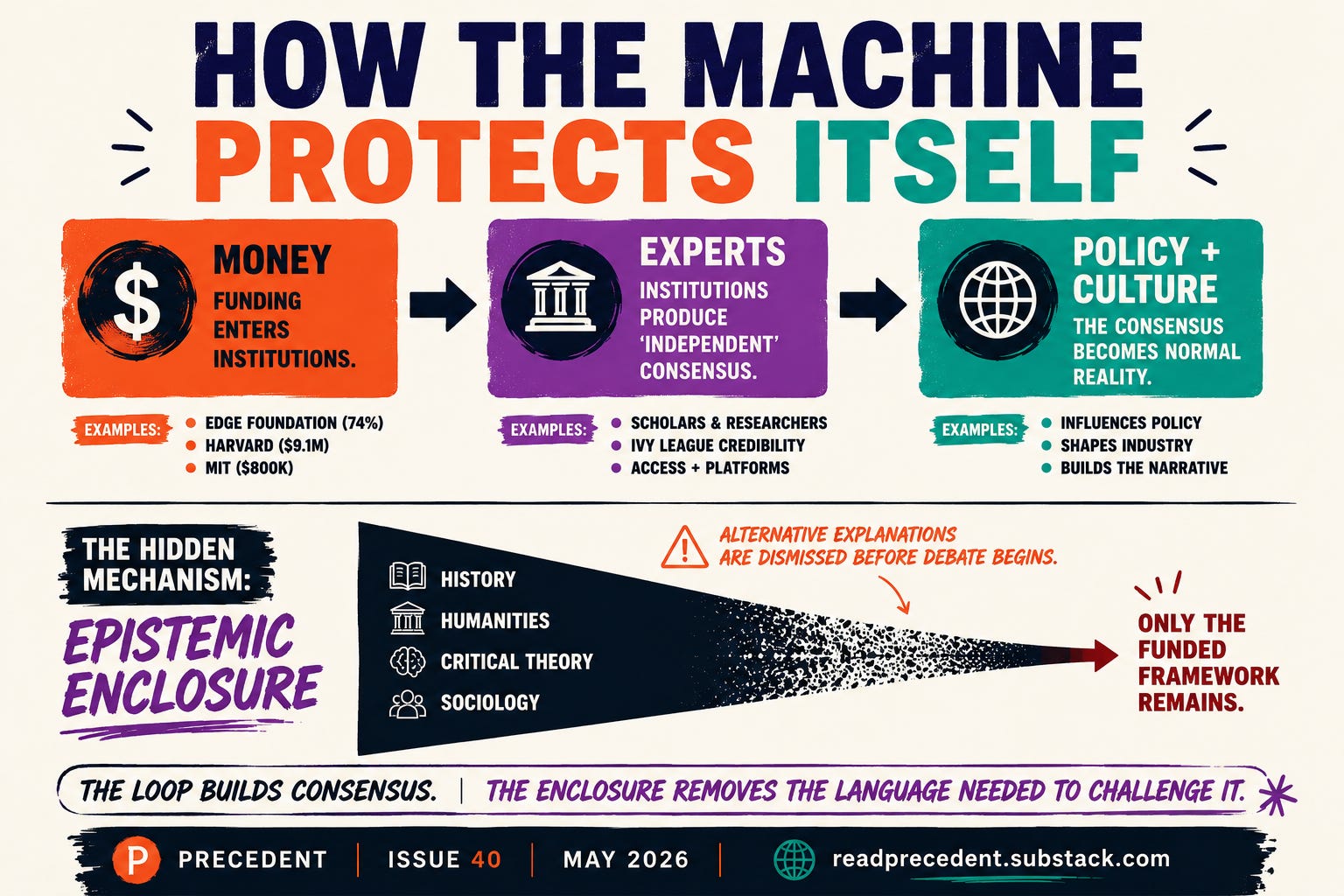
→ The precise documented funding chain: Edge Foundation at seventy-four percent, Harvard at $9.1 million, MIT at $800,000, and the individual researchers who carried the frameworks into the AI industry that now governs the next generation of cognitive infrastructure
→ Why the Epstein case is structurally more durable as a machine than the tobacco industry’s TIRC, and structurally more vulnerable to exposure than the defence think tank complex, and why that asymmetry is itself a data point about which version of the loop is most dangerous
→ The counter-case the article must acknowledge: what the federal document releases reveal about the one condition under which the loop’s invisibility fails, and what that condition means for the defence industry’s equivalent machine
→ What the AI industry’s inheritance from the Epstein network means for the expert consensus that will govern the next ten years of the most consequential technology in the recorded history of human production
Six cases were selected because each shows Epistemic Enclosure and the Expert Laundering Loop operating in tandem, at different phases, in different institutional registers, toward the same structural outcome: a funded ideology became the credentialed consensus, and the tradition that would have named what was happening was designated as unscientific, politically motivated, and intellectually inferior before the first paper was written.
📍 Start here: the address that made the ideology respectable
In September 2004, Jeffrey Epstein hosted a dinner at Harvard University. The photograph that has circulated since the Justice Department file releases shows Epstein at a table with Alan Dershowitz, Robert Trivers, Lawrence Summers, and Steven Pinker. Every person in that photograph held an appointment at a major research university. Epstein held an office at Harvard’s Program for Evolutionary Dynamics, funded by his own money, addressed in correspondence as a scientific interlocutor by some of the most credentialed scientists in the English-speaking world.
He was, as Virginia Heffernan documented in The Nerve in February 2026, a man who could barely read and write. He justified his own manifest illiteracy by saying that people who know how to write cannot think broadly, comparing himself to Socrates and Jesus. He addressed formal sessions at Harvard condemning the provision of food and care for the poor as though making a scholarly argument. He did all of this wearing a Harvard address, seated at tables with Nobel-adjacent scholars, photographed alongside the intellectual figures whose published work defined the policy and cultural consensus of the late twentieth and early twenty-first century.
The address was the mechanism. Not the ideas, which were his own and crude. The address was the Expert Laundering Loop in its most complete documented form: private financial interest, institutional credibility, and a consensus architecture that made the funder’s ideology indistinguishable from independent scholarship.
The Harvard address was purchased. $6.5 million in 2003 established the program that granted it. After the direct donation ban in 2008, a further $9 million was facilitated through associates with Harvard development staff assistance. The address outlasted the legal prohibition on paying for it directly, because the institutional relationship had already been built and the people who maintained it had their own reasons to continue maintaining it, reasons that had nothing to do with Epstein’s ideology and everything to do with how academic funding works, how careers are built inside institutions, and how the Expert Laundering Loop selects for the orientation it requires without ever issuing an instruction.
⚖️ The two mechanisms running together
The Expert Laundering Loop, as documented in Issue 13, operates in three phases. Selective funding shapes institutional orientation. Institutional credibility launders funded output into independent expert analysis. The laundered analysis becomes the baseline that future researchers must argue against. The mechanism does not require bad faith from any individual inside it. It requires only that the funding flows long enough.
The Epstein case adds a second mechanism operating alongside the first. Where the Expert Laundering Loop produces a consensus, Epistemic Enclosure eliminates the analytical tradition that would contest it.
Epistemic Enclosure is the structured delegitimisation of the intellectual disciplines that would produce the framework to name what the funding is doing. It is the complement to the loop, not a separate mechanism. The loop builds the consensus upward. Enclosure removes the ground from which a challenge would be mounted.
Edge Foundation was founded, in John Brockman’s own formulation, to oppose what he called “the sleepy wisdom of the humanities.” This was not an incidental intellectual position. It was the founding purpose of the organisation. The salon that granted Epstein access to the credentialed scientific world was constructed from the outset around the explicit rejection of the disciplines, critical theory, feminist scholarship, postcolonial analysis, the sociology of knowledge, that would have provided the analytical vocabulary to describe what Epstein was building inside it.
The Diversity Myth, published by Peter Thiel and David Sacks and circulated within the Edge network, argued that “diversity” was jargon concealing a nefarious political agenda. Charles Murray, an Edge presence, published work arguing for the intellectual inferiority of Black minds. The questions Pinker posed to the Edge audience in 2006, whether most victims of sexual abuse suffer lifelong damage, whether men have an innate tendency to rape, whether homosexuality is the symptom of an infectious disease, were not aberrations from the salon’s intellectual culture. They were expressions of it, produced by a network that had deliberately vacated the analytical tradition that would have named them as ideologically motivated rather than scientifically neutral.
Epistemic Enclosure and the Expert Laundering Loop together constitute a complete architecture. The loop builds the funded consensus. Enclosure prevents the tradition from forming that would contest it. A generation of scholars trained inside institutions whose intellectual culture was shaped by this architecture absorbed the lesson before they encountered the funding that shaped the culture.
📊 The three phases inside the Epstein machine
Phase 1: Selective patronage. Epstein did not commission specific papers arguing for eugenics. He funded the institutional contexts in which eugenics-adjacent ideas were produced as the natural output of the orientation he had selected and sponsored. The Edge Foundation received seventy-four percent of its budget from Epstein, which means it could not have existed in anything like its actual form without him. The Program for Evolutionary Dynamics could not have existed without his $6.5 million. Both institutions produced scholars and ideas that were published under their own names and their own credentials, with no visible connection to the man who made them financially viable.
Phase 2: Institutional laundering. A dinner at Harvard with Lawrence Summers and Steven Pinker is not the same event with Epstein removed and replaced by an unknown financier. The institutional setting, the Harvard address, the Nobel-adjacent attendees, the published output of the researchers present, these were the credibility that converted Epstein’s presence from that of a predator into that of a scientific patron. When the PED’s work appeared in peer-reviewed journals, it appeared as Harvard scholarship. When Edge Foundation’s annual questions were cited in popular science journalism, they were cited as the considered views of the world’s finest minds. The funding that made both institutions possible was in neither citation.
Phase 3: Consensus construction. The ideas that received sustained patronage through this network, evolutionary psychology’s darker applications, race science, the delegitimisation of sexual abuse as a cause of lasting harm, the naturalisation of hierarchy as a biological rather than political condition, accumulated into a body of credentialed output that shaped public and policy discourse across two decades. They became the baseline. The scholars who entered the relevant fields in the 2000s and 2010s encountered this as the established view against which their own work was positioned. The funding that produced the baseline was not visible in the baseline.
💬 “The address was the mechanism. Not Epstein’s ideas, which were his own and crude. The Harvard address, purchased for $6.5 million in 2003, was the Expert Laundering Loop in its most complete documented form: private financial interest, institutional credibility, and an ideology made indistinguishable from independent scholarship.”
🏛️ Case 1: Edge Foundation, 1996 to 2019, where the enclosure was the founding purpose
Edge began in 1996, in Brockman’s own account, to promote technological ideas and oppose the sleepy wisdom of the humanities. That phrase is not a casual description of an intellectual preference. It is the founding charter of an Epistemic Enclosure project, stated in the organisation’s own voice, directed at the precise academic disciplines that would have produced the vocabulary to analyse what the organisation was doing.
The humanities, in their full scope, include the history of science, the sociology of knowledge, feminist theory, postcolonial studies, the philosophy of mind, and the critical study of how expert consensus is produced and who funds it. These are the disciplines that examine the relationship between knowledge and power, between funding and intellectual output, between the credentials of the scholar and the interests of the patron. They are the disciplines that, had they been present in the Edge network with full intellectual standing, would have named the Expert Laundering Loop from the inside.
They were not present. They were designated as sleepy, as politically motivated, as intellectually inferior to the clean empiricism of evolutionary psychology and cognitive science. The designation was not incidental. It was operational.
Brockman’s literary agency represented the Edge scholars who defined the network’s intellectual output. Dawkins, Kahneman, Pinker, Taleb, Harari: the same figures whose published work reached millions of readers were Brockman’s clients, present at Brockman’s events, funded through Brockman’s patron. The literary agency, the foundation, the academic network, and the dominant financial backer were a single integrated machine with Brockman at the centre and Epstein’s money as the enabling condition.
What the Edge case discloses: Epistemic Enclosure does not require a conspiracy to declare which disciplines are legitimate. It requires only that the funded network consistently rewards one analytical tradition, consistently excludes another, and consistently presents the reward and the exclusion as the natural outcome of intellectual merit rather than of the funding that shaped who was in the room.
And crucially: Epstein’s place inside Edge was never concealed from its core members. Before 2008, the Foundation openly presented him as a benefactor and participant, illuminateing his scientific donations and placing him at the same tables as the emerging tech elite. His funding of Harvard’s Programme for Evolutionary Dynamics was celebrated. Edge seminars and prizes carried his name. Nothing about Epstein’s involvement was hidden from the people who moved through that world. The loop’s function is not concealment. The loop’s function is normalisation. Epstein’s name was in the programme. Nobody asked who else was in the programme with him.
The precise structural precedent is the Mont Pelerin Society, founded by Friedrich Hayek in Vevey, Switzerland, in April 1947. Hayek convened thirty-nine economists, historians, and philosophers at the Hotel du Parc with explicit purpose: to cultivate a global network of credentialed scholars who shared a broad orientation toward liberal economic order, place them in universities and policy institutions across three continents, and produce over time a consensus that would displace the Keynesian framework then dominant in Western economic governance. The funding came from the Volker Fund, from Swiss and German industrialists, and eventually from a dispersed base of foundations whose orientation was consonant with the project’s goals. No individual funder controlled the agenda. No scholar received instruction on what to conclude. The selection preceded the research.
Over thirty years, Mont Pelerin placed its scholars at Chicago, at LSE, at Freiburg, at universities across Latin America and Asia. Milton Friedman, George Stigler, James Buchanan, and Gary Becker all passed through or maintained affiliations. By the late 1970s, the framework those scholars produced had become the intellectual ground from which Reagan and Thatcher drew their economic programmes. The Washington Consensus, the set of policy prescriptions the IMF and World Bank imposed on developing economies through the 1980s and 1990s, was the Mont Pelerin Society’s intellectual output laundered through the credentialed independence of the universities, the journals, and the international financial institutions that housed its scholars.
The mechanism is identical to the three phases this article names. Selective patronage shaped institutional orientation. Institutional credibility laundered the funded output into independent expert analysis. The laundered analysis became the baseline against which future economists argued, which meant that even the economists who contested it were forced to conduct that contest inside the framework it had established.
Epstein’s Edge is Mont Pelerin with the stated agenda removed and something worse inserted in the space the statement vacated. Hayek declared his purpose in 1947. The Statement of Aims of the Mont Pelerin Society is a public document. The funding sources were dispersed enough, and the agenda consonant enough with existing academic traditions, that the Society’s scholars could plausibly argueand many genuinely believed that they were pursuing independent inquiry that happened to support liberal economic order. The ideology and the intellectual formation were at least aligned.
Epstein’s version recruited the credentialed network without stating the agenda the network was being assembled to serve. The scholars who attended the Edge dinners were not told they were being cultivated for a eugenics project. They were told they were the finest minds in the world, gathered by a man of unusual intellectual breadth, to ask the most important questions of the age. The flattery was the selection mechanism. The funding was the retention mechanism. The Harvard address was the laundering mechanism. The distinction between Mont Pelerin and Edge is not one of structure. It is one of disclosure. Hayek wrote down what he was building. Brockman kept the dinner reservation.
What both cases share, and what the tobacco case does not share with either of them, is the absence of the bad faith that disclosure law is designed to catch. C.C. Little suppressed evidence. Mont Pelerin and Edge did not suppress evidence. They funded the production of a particular kind of evidence, cultivated the scholars who would produce it, and delegitimised the traditions that would contextualise it. No document will ever surface from either institution showing that its founders knew their conclusions were false.
The machine does not require false conclusions. It requires only that the true conclusions it funds become the ones that count as the settled view.
🎓 Case 2: Harvard, 1998 to 2026, where the address was purchased and then maintained after the purchase was prohibited
Harvard’s internal review, completed in 2020, found that the university had received $9.1 million from Epstein between 1998 and 2008. Administrators maintain that donors have no say over who gets hired or what gets researched, but the superrich do not generally subsidise programs that do not interest them, and the Program for Evolutionary Dynamics would probably not have existed without Epstein’s millions.
That sentence from The Nation is the Expert Laundering Loop stated as a matter of institutional common sense. Donors fund programs that interest them. The programs produce work within the orientation the funding established. The work is published as independent scholarship. All three statements are true simultaneously. None of them requires bad faith.
After President Faust’s 2008 prohibition on direct donations, through a pattern of cooperation and engagement, and with the aid of some of Harvard’s most prominent academics, Epstein had been encouraged to facilitate the funding of Harvard’s academic work indirectly. Almost a year after the first report, Harvard took formal action against just one member of the Harvard faculty: Martin Nowak. His Program for Evolutionary Dynamics was shuttered, and he was banned from serving as a principal investigator on any academic research for two years.
One person formally disciplined. The program he ran, founded with Epstein’s money to pursue the intellectual orientation Epstein’s network promoted, produced an office for Epstein, a platform for Epstein at Harvard academic sessions, and a credentialed address that Epstein used for the remaining fifteen years of his contact with the academic world.
Lawrence Summers maintained contact with Epstein until the day before Epstein’s July 2019 arrest. Emails released by the House Oversight Committee in 2025 reignited questions about the relationship, with messages indicating a friendship that lasted well into 2019. Scrutiny on Summers intensified over recent months, culminating in his resignation from all academic and faculty roles at Harvard in February 2026. Summers also resigned from the board of OpenAI in November 2025.
What the Harvard case discloses: the Expert Laundering Loop survives the prohibition on its funding mechanism because the institutional orientation it produced persists after the funding relationship is formally severed. The program was built. The scholars trained inside it were trained. The credentialed output was published. The prohibition on further direct donations did not retroactively alter what the funding had already produced. The loop’s work, once done, does not need to be redone. The orientation it established becomes the culture of the institution, and the culture persists without the funding that created it.
And crucially: Harvard’s formal action ended with Nowak’s two-year ban from serving as a principal investigator. The Program for Evolutionary Dynamics was shuttered. No comparable accounting has been proposed for the intellectual legacy of the work it produced, the scholars it trained, or the consensus it contributed to building across two decades of published output.
💬 “Harvard took formal action against one person. The program he ran produced an office for a convicted sex offender, a Harvard platform for eugenics, and a credentialed address used for fifteen years of academic laundering. The formal action ended there. The intellectual legacy of the work the program produced was not part of the review.”
💻 Case 3: The AI pipeline, where the funded network seeded the next generation of cognitive infrastructure
Joscha Bach, an AI theorist and integral member of the Edge Foundation, worked across Harvard’s Program for Evolutionary Dynamics and the MIT Media Lab, two institutions that were recipients of Epstein’s post-conviction donations. Bach received more than one million dollars from Epstein, according to Der Spiegel. He has gone on to become a heavyweight in the AI industry, working with consequential organisations including the AI Foundation, the MIT-spinoff Liquid AI, and Intel Labs. His thinking on cognitive architectures, consciousness, and liquid neural systems has influenced how the top echelons of tech think about the next frontier in machine intelligence.
Bach is not alone. The Edge network at its height included Elon Musk, Bill Gates, Larry Page, and Sergey Brin among its billionaire attendees at the Billionaires’ Dinners. The intellectual frameworks produced by the Edge-funded academic network, the specific orientation of evolutionary psychology, cognitive science, and computational theory that was rewarded and promoted through twenty years of Epstein’s patronage, did not remain confined to academic journals. They passed into the founding intellectual cultures of the companies that now govern artificial intelligence, social media, and large-scale data systems.
The Epistemic Enclosure operated at this level too. The deliberate delegitimisation of the humanities within the Edge network was not merely an academic preference. It was the removal of the analytical vocabulary that would assess what the funded network was building. A generation of engineers, product designers, and AI researchers trained in the intellectual culture that Edge produced encountered the sociology of knowledge, the ethics of technology, and the study of how power shapes expert consensus as afterthoughts, mandatory corporate checkboxes, or active obstacles to progress. They encountered evolutionary psychology’s darker applications as the natural scientific baseline.
Bach was working across the Harvard Programme for Evolutionary Dynamics and the MIT Media Lab. Around this time, he received advanced drafts of Edge Foundation publications. After leaving MIT in 2016, Bach continued to use the programme’s office space, including to meet with Epstein. The Epstein-funded intellectual network and the AI research pipeline ran through the same offices, the same people, and the same institutional addresses during the period when the foundational architectures of current AI systems were being developed.
What the AI pipeline case discloses: the Expert Laundering Loop’s most significant long-run effect is not the specific policy outputs it produces. It is the intellectual formation it imposes on the researchers who will produce the next generation of expert consensus. Epstein’s network shaped the intellectual culture of the people who went on to shape artificial intelligence. The Epistemic Enclosure they absorbed as a formative orientation, the designation of the humanities as sleepy and the designation of evolutionary hierarchy as scientific, is now the default intellectual culture of an industry that will produce the expert consensus on the most consequential questions of the next century.
🇬🇧 Case 4: London and the international network, where the machine had no borders
The Epstein machine was not American. His private plane, which served meals from Le Cirque and was appointed with mink throws, transported Edge members to conferences and events across three continents. The file releases have produced documented connections to academic and institutional figures in Britain, France, Australia, and across the European university system.
Among the figures in the Epstein files: Geoffrey West, a British theoretical physicist and former president of the Santa Fe Institute, agreed to meet Epstein at his New Mexico ranch in 2012. Stephen Kosslyn, professor emeritus at Harvard, visited Epstein in jail in 2008 and met with him frequently. Renowned British neuropsychiatrist Peter Fenwick attempted to arrange meetings in Scotland in 2017. Harvard physicist Lisa Randall flew on Epstein’s private jet to his private island in 2014.
France’s former minister of culture Jack Lang, head of the Arab World Institute, announced his resignation in February 2026. Among the Justice Department documents is a video of Epstein and Lang outside the Louvre in Paris. Former British ambassador to the United States Peter Mandelson was fired from his ambassadorship by Prime Minister Keir Starmer in September 2025. Former Prince Andrew was arrested in February 2026 on suspicion of misusing his public office by supplying Epstein with confidential documents in his role as British trade envoy.
The international network was the loop operating across multiple national institutional registers simultaneously. Each country’s academic and political elite that entered the network brought its own institutional credibility. The credibility was pooled. The pooled credibility was what granted Epstein an address that transcended any single institution’s prestige. A man with a Harvard office, London contacts, Paris connections, and a private plane carrying the world’s finest minds was not a sex offender with money. He was a scientific patron with global reach. The loop produced that transformation. Epistemic Enclosure maintained it by removing from the network the analytical tradition that would have named it.
🌍 The mechanism across contexts
The Expert Laundering Loop and Epistemic Enclosure together constitute an architecture that operates wherever a well-resourced patron requires both a funded consensus and the removal of the tradition that would contest it..
In Europe, the rearmament consensus of 2025, documented in Issue 35 and Issue 38, was produced partly by think tanks whose funding from defence contractors is documented and largely unremarked upon. The Epistemic Enclosure within those think tanks is less visible but present: the analytical traditions most likely to contest military necessity as a structural imperative, peace studies, conflict transformation, economic analysis of the opportunity costs of defence spending, are consistently less well-funded, less credentialed, and less present in the policy networks that generate congressional testimony and government white papers.
In corporate environments, the epistemic enclosure operates as the designation of humanistic analysis as “soft,” “non-rigorous,” and “not data-driven” in contrast to the quantitative approaches that can be made to serve any conclusion the commissioning party requires. The management consultancy that commissions and produces the quantitative analysis is the funded institution. The organisational sociology, the labour history, and the political economy that would contextualise the numbers are the enclosed tradition.
💼 If you work inside an academic institution
The Epstein case discloses something about institutional life that the defence think tank case does not show as clearly: the loop does not require your awareness of the funding to shape your intellectual formation. The researchers at Harvard’s Program for Evolutionary Dynamics were not told that the funding that created their program came from a man who would eventually be charged with sex trafficking minors. They were told they were working in an academic paradise, as Nowak described it, pursuing cool problems in mathematical biology.
The intellectual culture of the program was formed before they arrived. The orientation was set by the funding that preceded them. The enclosure, the designation of the humanities and critical theory as sleepy and politically motivated, was the intellectual atmosphere they breathed inside the institution. They produced work within that culture as independent scholars, by their own lights and with their own credentials, and the work was published as independent scholarship.
The question the Epstein case poses most sharply is not whether individual researchers were compromised. It is what the institutional culture that was funded into existence produced over two decades of cumulative intellectual output, and what it would have taken for a researcher inside that culture to have perceived the relationship between the funding and the orientation as a question worth raising rather than a condition of the institutional air.
How the Shock Travels
The Expert Laundering Loop and Epistemic Enclosure travel into the future through three channels that are distinct from the channels documented in Issue 13.
The first channel is intellectual formation. The scholars trained inside the funded institutions carry the orientation with them into the next generation of academic appointments. The loop does not need to continue funding once the formation is complete. The orientation reproduces itself through the normal mechanisms of academic succession: doctoral training, postdoctoral appointments, hiring decisions, peer review, citation networks. The Epstein-funded intellectual culture is now being reproduced by scholars who have never heard of Edge Foundation and were not at the Harvard dinners.
The second channel is the AI industry’s intellectual inheritance. The computational architectures, the cognitive frameworks, and the theoretical orientations that were developed within the Epstein-funded academic network during the 2000s and 2010s are now instantiated in the systems that govern how two billion people encounter information, how hiring decisions are made at industrial scale, and how the next generation of artificial general intelligence is being theorised and built. The intellectual formation is not sitting in journals. It is running in production systems.
The third channel is the policy citation trail documented in Issue 13. The publications of scholars who were funded, hosted, or intellectually formed through the Edge and Harvard network are cited in policy documents, congressional testimony, and regulatory frameworks. The citations do not carry the funding disclosure that would make the trail visible. They carry the institutional credentials of the scholar and the publication venue. The loop’s output, once in the citation ecosystem, reproduces itself through the authority of accumulated attribution.
As documented in The Expert Is Paid by the Industry the Expert Is Assessing, the think tanks that assess whether military spending requires justification are funded by the institutions whose existence requires that justification to hold. The Epstein case extends this principle: the intellectual salon that assessed whether hierarchy, genetic determinism, and the natural inferiority of some human populations were legitimate scientific positions was funded by the man whose ambitions required that assessment to conclude in the affirmative. The mechanism in both cases is identical. The federal investigation that produced the document dumps is the one structural difference, and that difference is the article’s counter-case.
The Human Layer
The person bearing this in May 2026 is not the predator, who is dead, or the academics who attended the dinners, whose institutional consequences are now a matter of public record. The person bearing this is the researcher who is producing work in 2026 within an intellectual culture that was shaped, in ways she cannot fully trace, by the funding decisions of a man she has never heard of and a salon she was never invited to join.
The women were deliberately excluded from the Edge network. Heffernan documented this: female members were kept at arm’s length, excluded from the Billionaires’ Dinners, excluded from the conferences, maintained at a distance from the events where the intellectual culture was formed and the patronage relationships were solidified. The Epistemic Enclosure operated at the level of the physical room. The analytical traditions most likely to name what was happening were excluded. The people most likely to carry those traditions were excluded. Both forms of exclusion were the same mechanism expressed at two different scales.
The survivor whose diary appeared in the 2025 Justice Department file releases described herself as an incubator, recording what she characterised as a Nazi-like effort to create a superior gene pool. That testimony is not the article’s subject. It is cited once, precisely, because it establishes that the eugenics project was not theoretical, and because the documents that produced it are the counter-case that this article must acknowledge: the one condition under which the Expert Laundering Loop’s invisibility fails.
The loop’s most durable feature is that it keeps its own evidence invisible. The defence industry’s think tank complex has no federal criminal investigation producing document dumps. The Epstein network did. The visibility of the Epstein machine is not a function of the machine’s being different from the defence industry’s version. It is a function of the crimes being serious enough to generate the federal investigation that forced the documents into the public record. The machine is the same. The crimes produced the receipts. Without the receipts, the machine is the defence think tank complex, funding analysis of its own necessity with no federal investigator in view.
🎯 The pattern
Six cases examined. Two mechanisms across all of them.
Edge Foundation, 1996 to 2019 = the Expert Laundering Loop and Epistemic Enclosure operating as a single integrated machine, where the funding produced the consensus and the founding purpose produced the enclosure, and where the dominant financial patron was responsible for seventy-four percent of the organisation’s budget for two decades.
Harvard’s Program for Evolutionary Dynamics, 2003 to 2021 = the address that was purchased, the address that was maintained after the purchase was prohibited, the one person formally disciplined, and the intellectual legacy of the work the program produced that was not subject to any formal review.
The AI industry pipeline, 2015 to 2026 = the channel through which the intellectual formation produced by the funded network passed into the systems that govern the next generation of cognitive infrastructure, carried by researchers who absorbed the orientation as the natural intellectual culture of the institutions they worked inside.
Lawrence Summers, 1998 to 2019 = the most senior institutional figure whose sustained contact with Epstein is now documented to the day before the arrest, whose resignation from Harvard and from OpenAI in November and February 2025 to 2026 marks the furthest reach of the formal institutional consequences, and whose contact ended where the federal arrest began rather than where the conviction occurred eleven years earlier.
The international network, London, Paris, and beyond = the machine operating across multiple national institutional registers simultaneously, pooling credibility from each country’s academic and political elite, producing an address that transcended any single institution’s prestige, and collapsing when the federal document releases produced the evidence that the loop normally keeps in the filing room.
The federal document releases, 2019 to 2026 = the counter-case. The one condition under which the Expert Laundering Loop’s invisibility fails is a federal criminal investigation serious enough to produce compelled document production. That condition does not exist for the defence industry’s think tank complex. It existed for the Epstein network because the crimes that ran alongside the funding mechanism were serious enough to generate it. The machine in both cases is the same. The receipts exist for one case because of what happened in the rooms where the other machine does not need to go.
The Expert Laundering Loop does not choose what it launders. That is its most important structural feature and its most important structural danger. The tobacco industry used it for cigarettes. The defence industry uses it for arms policy. Epstein used it for eugenics. The mechanism in all three cases was identical. The documents are public for one of them because a federal investigation forced them. They are partially public for the second because a research institution built a tracker. They remain proprietary for the third because no equivalent compulsion exists.
The machinery runs as long as the loop’s evidence remains invisible. The question the next decade will answer is whether the institutions that depend on the loop’s invisibility face any equivalent compulsion before the intellectual formation it is currently producing in the world’s AI laboratories becomes, as it already is in certain institutions, the baseline that future researchers must argue against.
If this changed how you read the next expert cited on evolutionary psychology, artificial intelligence, or genetic determinism, SUBSCRIBE. If it didn’t, tell me why. I read everything.
References
Virginia Heffernan, “The billionaires’ eugenics project: how Epstein infiltrated Harvard, muzzled the humanities and preached master-race science,” The Nerve, February 13, 2026 Epstein Exposed, “John Brockman: Epstein Files Profile,” epsteinexposed.com, April 2026, source for seventy-four percent Edge Foundation funding figure Axios Boston,
“Harvard’s Epstein ties: the Summers emails and the $9.1 million,” newsletter, 2025-2026. $6.5 million PED gift, Summers contact timeline The Harvard Crimson,
“The First Epstein Report Ignored Summers. Harvard Must Do Better,” November 25, 2025. Nowak disciplinary action, program closure, indirect $9 million facilitation The Nation,
“How Jeffrey Epstein Captivated Harvard,” August 2023. PED founding, Epstein office access, donor orientation argument MIT President L. Rafael Reif, public statement on MIT and Jeffrey Epstein, MIT website, August 22, 2019. $800,000 total over 20 years, Media Lab and Seth Lloyd Boston Globe, “MIT’s Joscha Bach: Controversial Epstein emails revealed,” November 21, 2025. Bach office access at PED, Liquid AI termination Times Higher Education, “He was surrounded by smart people: academics in Epstein files,” February 24, 2026. international network, Geoffrey West, Bach million-dollar figure, Epstein 2015 email Byline Times, “How Epstein Channelled Race Science and Climate Culling Into Silicon Valley’s AI Elite,” December 5, 2025. Bach, Edge anthology, AI industry pipeline Scientific American, “Why did Jeffrey Epstein cultivate famous scientists?”, January 2026. Pinker, Brockman literary agency, Dershowitz legal opinion Britannica, “Epstein Files Fallout: The Resignations, Firings and Arrests,” updated April 2026. Summers OpenAI, Summers Harvard, Mandelson, Lang, Prince Andrew arrest Yahoo Finance / The Guardian, “Larry Summers to resign from Harvard after Epstein files revelations,” February 25, 2026 Factually.co, “Which universities received research grants linked to Jeffrey Epstein?”, December 16, 2025. institutional amounts, Harvard dispute over $30 million claim Quincy Institute for Responsible Statecraft, “Big Ideas and Big Money: Think Tank Funding in America,” Quincy Brief No. 68, January 2025. defence think tank comparison figures PRECEDENT, “The Expert Is Paid by the Industry the Expert Is Assessing,” Issue 38, May 2026, The Innovation Alibi: Why the $679 Billion War Economy Cannot Afford Peace, Issue 35.
If you’d like to support the hours of research that go into these posts, you can support Precedent. Your contributions help keep this resource free and accessible for everyone.