
How Democracies Have Died Before And the Warning Signs You Should Actually Watch For
The playbook hasn’t changed. The people running it are counting on you not knowing that.

On January 30, 1933, Adolf Hitler was appointed Chancellor of Germany.
He did not seize power. He was handed it.
The man who handed it to him was Franz von Papen - a Catholic aristocrat, former German Chancellor, member of the old Prussian officer class, and one of the most sophisticated political operators in Weimar Germany.
Von Papen was not a Nazi. He found Hitler vulgar, his supporters uncouth, and his movement dangerous. But he also believed he could use Hitler.
The arrangement was a coalition cabinet. Hitler would be Chancellor. Von Papen would be Vice-Chancellor. Of the eleven cabinet seats, only three would go to Nazis. Von Papen and his conservative allies would hold the rest — including the crucial ministries of Foreign Affairs, Finance, and Defence.
Von Papen told a friend, on the eve of the appointment, words that would become one of the most quoted sentences in the historical study of democratic collapse:
“We’ve hired him. In two months we’ll have pushed him so far into a corner that he’ll squeal.”
Within 28 days, the Reichstag was set on fire. The Reichstag Fire Decree, signed February 28, 1933, suspended civil liberties across Germany.
Within 53 days, the Enabling Act passed, giving Hitler’s government the power to enact laws without parliamentary approval. It was passed by the Reichstag itself, 441 votes to 94. A democratic legislature voted away its own function.
Within 6 months, every political party other than the Nazis was banned. Within 18 months, every civil servant, judge, and soldier had sworn a personal oath not to Germany, not to its constitution, but to Adolf Hitler by name.
Von Papen was still Vice-Chancellor. He had no power. He had never had any power.
He had confused institutional position with institutional power. He controlled the chair. Hitler controlled what the chair meant.
Most people think democracies die when someone seizes power. They are wrong about the mechanism. The seizure is the last step. By the time it happens, everything that needed to happen has already happened.
The courts have been softened. The press has been discredited. The elites have accommodated. The language has shifted.
What people see as the moment of collapse is actually the moment the collapse becomes visible. The collapse itself happened earlier. Quietly. Legally. Incrementally.
The pattern in one sentence:
Democratic collapse is not what happens to democracies. It is what skilled operators do to them. And it always begins long before anyone calls it what it is.
Why It Keeps Happening ? The Three Phase Mechanism.
When you map the successful captures of modern history, Weimar Germany 1930 to 1933, Chávez’s Venezuela 1999 to 2007, Orbán’s Hungary 2010 to 2018, Erdoğan’s Turkey 2013 to 2017, Fujimori’s Peru 1990 to 1992 a consistent operational sequence appears.
Not identical. Structurally identical. Different countries running the same playbook, translated into local language.
The First Move Is Never Institutional. It Is Cultural.
Before any democracy can be captured, its legitimacy infrastructure must first be corroded. This phase does not seize power. It pre-justifies seizing power.
The evidence from three cases is precise.
Weimar Germany: 1930 to 1932.
The Nazi Party’s vote share in 1928 was 2.6 percent. It was a fringe movement with twelve seats in the Reichstag, widely considered unelectable outside its narrow base of rural Protestants and discontented veterans.
By July 1932 four years later the Nazis were the largest party in Germany with 37.3 percent of the vote and 230 seats.
What happened between 1928 and 1932 was not primarily economic, though the Depression mattered. What happened was the systematic destruction of Weimar’s legitimacy in the eyes of the German middle class.
Joseph Goebbels, who took over Nazi propaganda in 1930, understood what he was building. He called it die Systemzeit the System Time. The Weimar Republic was not a legitimate German state, in this framing. It was a foreign imposition engineered by the Versailles powers, run by the Novemberverbrecher (November Criminals) who had stabbed the German army in the back in 1918, corrupted by Jewish financial interests, and presiding over the systematic humiliation of the German nation.
Every institution of the Republic was mapped onto this framing. The Reichstag was not a parliament it was a talking shop run by traitors and profiteers. The press was not free it was a Lügenpresse, a lying press, controlled by foreign and Jewish interests. The courts were not independent they were instruments of the System protecting itself from German justice.
By the time the actual political crisis arrived in 1930 to 1932, a large portion of the German middle class no longer believed the Weimar Republic was worth defending.
Not because they were Nazis. Because they had been convinced, over years of cultural delegitimization, that the institutions being attacked had no legitimate claim to their defence.
Venezuela: 1999 to 2001.
Hugo Chávez won the 1998 presidential election with 56 percent of the vote. He did not attack democracy directly. He attacked Venezuelan democracy specifically, the institutional framework known as the Punto Fijo system that had governed the country since 1958.
The Punto Fijo system was a power-sharing arrangement between the country’s two main parties, AD and COPEI. It had produced 40 years of electoral alternation, relatively peaceful transfers of power, and its critics correctly observed a deeply corrupt elite consensus that enriched connected insiders while vast oil wealth failed to reach the Venezuelan poor.
Chávez’s delegitimisation campaign did not invent these grievances. They were real. That was what made the campaign effective.
What Chávez constructed was a complete alternative narrative in which all existing Venezuelan institutions the Supreme Court, the Congress, the state oil company PDVSA, the Catholic Church hierarchy, the independent media, and the business federation Fedecámaras were not institutions. They were La Oligarquía. A single integrated elite network that existed to oppress the Venezuelan people.
By 2001, polling showed that a majority of Venezuelans agreed with the framing that the old institutions were illegitimate.
This was the permission structure. Within three years, the Supreme Court had been restructured from 20 to 32 justices, all appointed by the Chávez-controlled National Assembly. PDVSA’s management had been purged. The private media had been subjected to a licensing regime that pulled television stations off the air for editorial content.
None of these moves were possible in 1999. All of them were possible by 2003. The institutions had not changed. The belief about their legitimacy had.
Hungary: 2010 to 2014.
Viktor Orbán’s case is the most methodically documented because it happened most recently and in full public view.
Orbán’s Fidesz party won the 2010 election with 52.7 percent of the vote which, under Hungary’s electoral system, translated into 68 percent of parliamentary seats. A two-thirds supermajority. Constitutional amendment power.
But Orbán did not begin with constitutional changes. He began with media.
Between 2010 and 2014, Fidesz-aligned business figures acquired Hungary’s largest commercial broadcaster (TV2), the largest daily newspaper (Magyar Nemzet), and dozens of regional outlets. By 2018, a single pro-government conglomerate called KESMA controlled 476 media outlets.
The narrative produced across these outlets was specific and consistent. Hungary’s post-1989 institutions were not Hungarian institutions. They were impositions engineered by the European Union, funded by George Soros, controlled by foreign NGOs, and presiding over the systematic erosion of Hungarian Christian civilisation.
By 2014, a majority of Fidesz voters believed that independent Hungarian media did not exist that all critical coverage of the government was foreign-directed interference.
The permission structure was complete. The constitutional rewriting that began in 2011 was, from that point, widely understood by Orbán’s electoral base not as an attack on Hungarian democracy but as its restoration.
Legitimacy is an infrastructure. It can be dismantled the same way any infrastructure can quietly, piece by piece, before anyone notices the structure is gone.
In all three cases Weimar, Venezuela, Hungary the institutional capture that followed was only possible because the cultural capture preceded it. The historical tell is not the most extreme rhetoric. It is the normalisation gradient how quickly yesterday’s outrage becomes today’s baseline.
When the public stops being shocked, the first phase has succeeded
The Second Move Is Always Legal
Every constitution is a partial document.
Written rules cannot cover every situation, so democratic systems depend on unwritten norms the informal agreements that fill the gaps.
The ruling party does not pack the courts. The opposition does not weaponize procedure to paralyse governance. State resources are not deployed for partisan campaigns. The losing side accepts the result.
These norms exist because both sides once agreed implicitly that restraint served their long-term interest. The game was worth preserving because they expected to play it again.
The second phase begins when one player decides to defect from that agreement.
What follows is entirely legal. It is designed to be.
Hungary, 2011: The Fundamental Law.
Less than a year after taking office, Orbán’s government replaced Hungary’s constitution.
The new constitution called the Fundamental Law was drafted by a parliamentary committee in 35 days. The opposition was given essentially no role in drafting. Public consultation was perfunctory. It was passed by Fidesz’s two-thirds majority alone, adopted on April 25, 2011, and entered into force on January 1, 2012.
Every step was legal under Hungary’s existing constitutional framework. No laws were broken. What the new constitution did was legal too.
It reduced the number of parliamentary seats from 386 to 199 and redrew every electoral district in the country through a process controlled entirely by Fidesz appointees. The new districts produced a structural advantage for Fidesz that independent analyses estimated at 4 to 6 percentage points. In a genuinely competitive election, this would convert a 45 percent Fidesz vote share into a parliamentary majority.
It restructured the Constitutional Court expanding it from 11 to 15 justices, all the new appointments controlled by Fidesz, and removed the Court’s authority to review most fiscal legislation.
It created a new Media Council with sweeping regulatory powers, all five members appointed by Fidesz for nine-year terms.
It shortened the judicial retirement age from 70 to 62, forcing the immediate retirement of 274 senior judges and replacing them through a new judicial appointment body controlled by a Fidesz-appointed chief justice.
All of it was legal. All of it was constitutional — under the constitution that Fidesz itself had just written.
By the time the opposition understood what had been built, the electoral terrain, the courts, the media regulation, and the judiciary itself had all been restructured to make Fidesz’s position structurally permanent.
Venezuela, 1999: The Bolivarian Constitution.
Chávez ran the same play six months into his first term.
In April 1999, Venezuelans voted in a referendum to call a Constituent Assembly to write a new constitution. Chávez’s coalition won 121 of 131 seats in that assembly — a 92 percent supermajority achieved through an electoral system that converted a 60 percent vote share into 92 percent of the seats.
The new Constitution of 1999 was drafted in three months and approved by a 71.8 percent referendum vote with 55 percent turnout.
What the constitution did: it extended the presidential term from 5 to 6 years. It permitted one consecutive re-election. It replaced the bicameral Congress with a unicameral National Assembly. It gave the President authority to legislate by decree under an “enabling law” mechanism which Chávez would use in 2000, 2001, 2007, and 2010 to enact fundamental changes without legislative debate. It restructured the Supreme Court which Chávez’s allies packed by expanding it in 2004.
Every step was legal. The Venezuelan people had voted for the constitution. The constitution had voted for itself.
Peru, 1992: The Self-Coup.
Alberto Fujimori’s case is included here because it shows what happens when the legal route is not taken and why no successful modern democratic capture has repeated his approach.
On April 5, 1992, Fujimori elected president in 1990 with 56 percent of the vote appeared on national television and announced that he was dissolving Congress, suspending the judiciary, and ruling by decree until a new constitution could be written.
It was a textbook coup. It was also, briefly, popular with approval ratings reaching 73 percent as Fujimori claimed the emergency was necessary to address the Shining Path insurgency.
But Fujimori paid a cost that Orbán and Chávez avoided. The Organization of American States imposed sanctions. International legitimacy was compromised. He was forced to hold elections for a Constituent Congress within a year under international monitoring that constrained his options.
Every subsequent authoritarian operating in a democratic system has learned the lesson.
You do not dissolve parliament. You convert it.
You do not suspend the constitution. You rewrite it legally, using the majorities it allows you to build.
The old-style coup is obsolete. The new-style constitutional capture is harder to name, harder to resist, and produces more durable results.
The constitution is defended by what people believe about it. When belief erodes, the text remains. But the document protects nothing.
The Endgame Is Never the Abolition of Elections
The final phase of democratic capture is not the abolition of elections. It is the colonisation of the institutions that certify their results.
Courts. Electoral commissions. Prosecutorial agencies. Military command. Civil service leadership. Regulatory bodies.
Turkey, 2013 to 2017: The Gülenist Purge.
Recep Tayyip Erdoğan’s case shows the referee-capture phase in full operation.
Erdogan had governed Turkey since 2003. For the first decade of his rule, he operated alongside a powerful allied movement — the followers of cleric Fethullah Gülen, who held significant positions in Turkey’s judiciary, police, and civil service.
In December 2013, Gülenist prosecutors opened a corruption investigation that reached into Erdoğan’s own family. Erdoğan’s response was not to fight the charges legally. It was to restructure the institutions that could prosecute him.
Between December 2013 and July 2016, approximately 3,500 judges and prosecutors were reassigned or dismissed. The Constitutional Court was restructured. The Supreme Board of Judges and Prosecutors which controlled judicial appointments was brought under executive control through a 2014 constitutional amendment.
Then came July 15, 2016 the attempted coup.
Whatever its true origins and this remains genuinely disputed among serious analysts its political effect was to provide Erdoğan with an unlimited mandate for institutional purging.
Within 48 hours, approximately 2,745 judges and prosecutors were suspended. Within a week, 21,000 teachers had their licences revoked. Within a month, more than 100,000 civil servants had been dismissed. Within a year, 130,000 military personnel, police officers, teachers, academics, and civil servants had been purged.
The state survived. Its institutions did not. Every significant position in the Turkish judiciary, civil service, military, and education system had been filled with people whose primary qualification was loyalty to the ruling party.
Rome, 133 to 49 BC: The Two-Century Version.
The Roman Republic’s final century shows the same mechanism operating on a civilisational timescale. The Senate’s collapse was not caused by Caesar alone. It was caused by a century of eroding institutional independence.
In 133 BC, Tiberius Gracchus a reforming tribune was beaten to death on the Capitoline Hill by senators wielding broken furniture. This was the first political assassination in Rome in nearly four centuries. It did not restore institutional order. It demonstrated that institutional order was now negotiable.
In 121 BC, Tiberius’s brother Gaius Gracchus was driven to suicide during a senatorial purge that killed approximately 3,000 of his supporters under a newly invented legal instrument, the senatus consultum ultimum — the senate’s “final decree,” which authorised the suspension of civil protections for political opponents.
Over the next 80 years, that emergency instrument was used repeatedly — against the Gracchan reformers, against Saturninus, against the Catilinarian conspirators, against the allies of Julius Caesar in 49 BC. What had been unthinkable in 133 BC was normal by 50 BC.
By the 80s BC, Roman generals routinely used their armies as personal political instruments. Sulla marched on Rome twice and held dictatorial power for life. Marius raised private armies. Pompey built a military career explicitly outside senatorial control.
By the 60s BC, Roman courts prosecuted political opponents rather than legal violations. The trials of Cicero’s political enemies, and later of Cicero himself, were not legal proceedings in any meaningful sense. They were instruments of factional combat.
Caesar was the culmination of this process, not its origin. By 49 BC, when he crossed the Rubicon, every institutional norm that might have restrained him had been eroded over the preceding century by the side that believed it was defending the Republic.
The question is never why Caesar. The question is always: what structural failure points made Caesar possible?
The referee is not neutral because the rules say so. The referee is neutral because the culture says so. Change the culture. The rules become instruments.
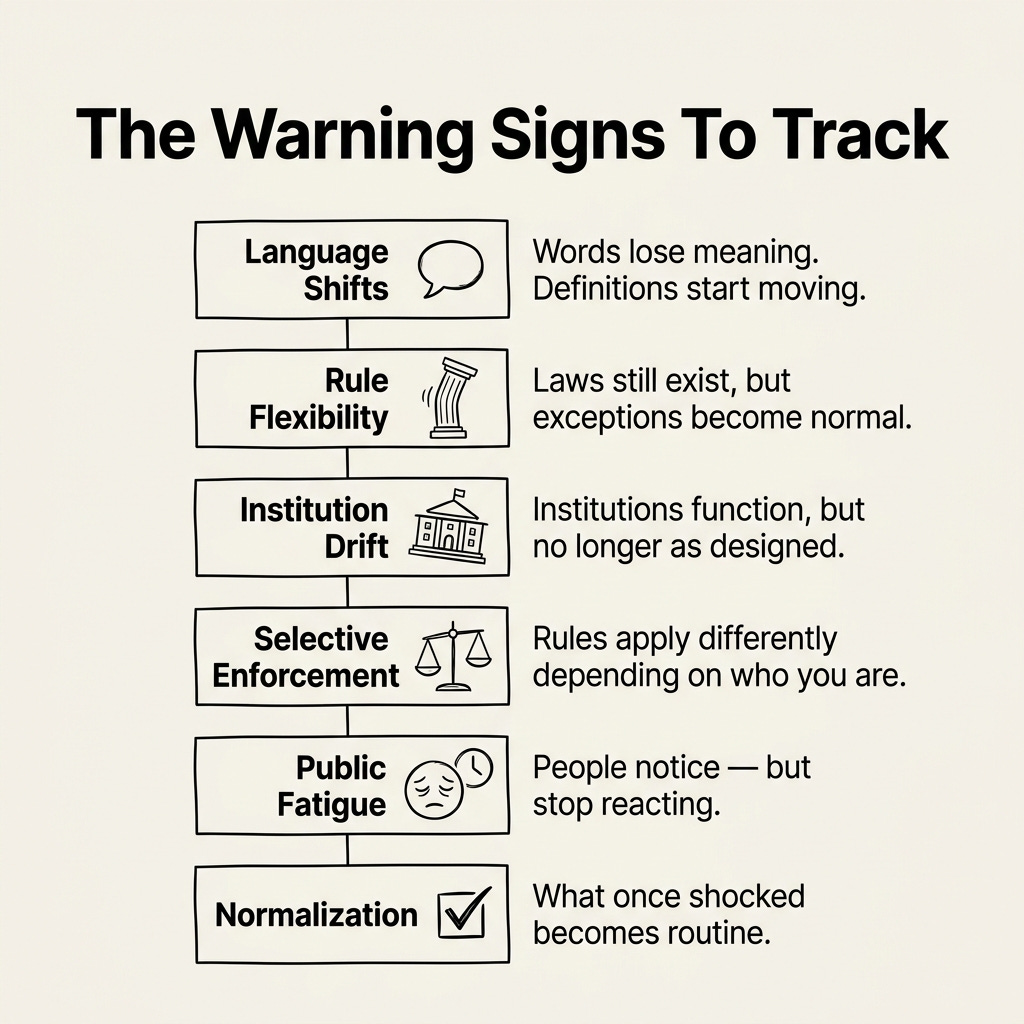
The Warning Signs To Track
Not the extreme events. The gradients.
When legitimacy is contested as a principle, not a grievance. Every democracy produces disputed results. The warning sign is when challenge becomes systemic rejection when the argument shifts from this election was flawed to elections of this type cannot produce legitimate results. That is narrative infrastructure for what comes next. Goebbels ran this in 1930. Chávez ran it in 2000. Orbán ran it in 2014.
When the vocabulary of competition becomes the vocabulary of elimination. In functioning democracies, opponents are rivals. In pre-collapse democracies, they become enemies, criminals, traitors, foreign agents, threats to civilisation itself. Weimar’s Communists were Bolshevist agents. Venezuela’s opposition was La Escuálida the squalid ones, gusanos, worms. Turkey’s opposition became terrorists. When the language shifts from defeat to remove, the underlying logic of democratic restraint has already broken down.
When elite accommodation is dressed as pragmatism. Von Papen’s calculation was rational by the standards of 1933 political analysis. So was the Venezuelan business class’s decision to work with Chávez’s first administration. So was the Hungarian opposition’s decision in 2010 to treat Fidesz’s early moves as ordinary politics. Elite accommodation in phase one makes phase two possible. Phase two makes phase three irreversible. Watch who is making the accommodation argument. Trace their incentives carefully.
When reform is used to close competition rather than improve it. Electoral reform. Judicial restructuring. Constitutional revision. Civil service modernisation. These are legitimate policy domains. They are also the primary mechanisms through which democratic capture operates. Hungary’s 2011 constitution was electoral reform. Venezuela’s 1999 Bolivarian Constitution was democratic renewal. Turkey’s 2017 constitutional referendum was government modernisation. The tell is not the instrument. It is the design intent.
When the pace of norm erosion accelerates. Single incidents are rarely definitive. Trajectories are. If what was unthinkable twelve months ago is now merely controversial and what was controversial is now normalised you are watching a directed campaign. Not a natural drift.
The warning signs are never invisible. They are always visible. The question is whether the people watching them understand what they are looking at.
Why Capture Is Always Easier Than Defence
The historical record confirms one structural reality most political analysis refuses to state plainly:
The playbook for democratic capture is operationally easier to execute than the playbook for democratic defence.
Capture requires a small coordinated elite. It moves incrementally each step individually deniable. It exploits the institutional tendency to normalise rather than confront.
Defence requires large coalitions. It demands people sacrifice short-term interests for long-term institutional preservation. It must operate within the very norms the other side is treating as optional. This creates a permanent asymmetric constraint.
Defenders of democracy have, in case after case, been tactically right and strategically wrong. They won the arguments. They lost the institutions.
The cases where democratic erosion was actually reversed are rare. Three stand out.
South Korea, 1987. A massive pro-democracy movement, built over seven years of clandestine organising after the Gwangju Massacre of 1980, produced the June Democratic Struggle weeks of nationwide protests involving millions of people that forced the ruling military junta to accept direct presidential elections and constitutional reform.
Chile, 1988. The Pinochet regime, in an effort at international legitimacy, held a plebiscite asking Chileans to approve an eight-year extension of his rule. The No campaign a coalition of 17 opposition parties that had been illegal weeks earlier built a television and ground campaign organised around a single word: No. Pinochet lost 56 to 44 percent. Within two years, he was out of power.
Spain, 1975 to 1977. After Franco’s death, Spanish elites, opposition leaders, and reformers within the Francoist state negotiated a transition to democracy the Pact of Moncloa that traded amnesty for the past in exchange for constitutional reform and free elections. It was imperfect. It held.
What these three cases share is not similar threat levels. The threats were different. What they share is a common structural feature in the defence.
In each case, the pro-democracy coalition won the cultural and narrative battle before it won the institutional one. It built a story about what was at stake that was more emotionally and politically compelling than the story being told on the other side.
Fact correction alone has never defeated a narrative campaign. Counter-narrative has.
The Pattern Is Simple
Von Papen had all the institutional levers. He lost because he misunderstood what game was being played.
The warning signs were present in Weimar in 1930. They were present in Rome in 133 BC. They were present in Venezuela in 1998, in Hungary in 2010, in Turkey in 2013.
People were naming them. Writing about them. Organising against them.
What was insufficient was the translation of recognition into action. Awareness that does not become architecture changes nothing.
Democracies do not die when the strongman arrives. They die in the years before when everyone who should have acted decided it was not yet serious enough.
This is not new. It repeats.
This is not new. The instruments have been refined many times. Augustus adapted them to empire. Goebbels industrialised them through mass media. Chávez constitutionalised them. Orbán rebuilt them as a legal system. The instruments change with the technology and legal culture of their moment. The function repeats: concentrate power by disabling the norms that restrained its use..
The only variable that changes is whether the people watching it understand what they are watching early enough to matter.
“Share this with someone who would recognise this pattern if it appeared in their country.”
References:
Levitsky, Steven and Way, Lucan A. Competitive Authoritarianism: Hybrid Regimes After the Cold War. Cambridge University Press, 2010.
Levitsky, Steven and Way, Lucan A. “The New Competitive Authoritarianism.” Journal of Democracy, Vol. 31, No. 1, January 2020, pp. 51–65.
Levitsky, Steven and Ziblatt, Daniel. How Democracies Die. Crown Publishing, 2018.
Evans, Richard J. The Coming of the Third Reich. Penguin, 2003.
Kershaw, Ian. Hitler: Hubris, 1889–1936. Allen Lane, 1998.
Bracher, Karl Dietrich. The German Dictatorship. Praeger, 1970.
Longerich, Peter. Goebbels: A Biography. Random House, 2015.
Corrales, Javier and Penfold, Michael. Dragon in the Tropics. Brookings Institution Press, 2nd ed., 2015.
Brewer-Carías, Allan R. Dismantling Democracy in Venezuela. Cambridge University Press, 2010.
Cannon, Barry. Hugo Chávez and the Bolivarian Revolution. Manchester University Press, 2009.
Bánkuti, Miklós, Halmai, Gábor, and Scheppele, Kim Lane. “Disabling the Constitution.” Journal of Democracy, Vol. 23, No. 3, July 2012, pp. 138–146.
Scheppele, Kim Lane. “Constitutional Coups and Judicial Review.” Transnational Law and Contemporary Problems, Vol. 23, 2014.
Polyák, Gábor. “Context, Rules and Praxis of Media Regulation in Hungary.” Mérték Media Monitor, 2015.
Bozóki, András and Hegedűs, Dániel. “An Externally Constrained Hybrid Regime.” Democratization, Vol. 25, No. 7, 2018, pp. 1173–1189.
Esen, Berk and Gumuscu, Sebnem. “Rising Competitive Authoritarianism in Turkey.” Third World Quarterly, Vol. 37, No. 9, 2016, pp. 1581–1606.
Baser, Bahar and Öztürk, Ahmet Erdi. Authoritarian Politics in Turkey. I.B. Tauris, 2017.
Akkoyunlu, Karabekir and Öktem, Kerem. “Existential Insecurity and the Making of a Weak Authoritarian Regime in Turkey.” Southeast European and Black Sea Studies, Vol. 16, No. 4, 2016, pp. 505–527.
Beard, Mary. SPQR: A History of Ancient Rome. Profile Books, 2015.
Flower, Harriet. Roman Republics. Princeton University Press, 2010.
Gruen, Erich S. The Last Generation of the Roman Republic. University of California Press, 1974.
Syme, Ronald. The Roman Revolution. Oxford University Press, 1939.
Cameron, Maxwell A. “Self-Coups: Peru, Guatemala, and Russia.” Journal of Democracy, Vol. 9, No. 1, January 1998, pp. 125–139.
Levitsky, Steven. “Fujimori and Post-Party Politics in Peru.” Journal of Democracy, Vol. 10, No. 3, July 1999, pp. 78–92.
Shin, Doh C. Mass Politics and Culture in Democratizing Korea. Cambridge University Press, 1999.
Constable, Pamela and Valenzuela, Arturo. A Nation of Enemies: Chile Under Pinochet. W.W. Norton, 1991.
Linz, Juan J. and Stepan, Alfred. Problems of Democratic Transition and Consolidation. Johns Hopkins University Press, 1996.
“This kind of work takes time. If it was worth yours, I'd appreciate a coffee."
🔥💙🔥