
The Second Enclosure: They Took the Commons Once with Fences. They Are Taking It Again with Apps."
"The fence is different. The app is different. The outcome is the same."

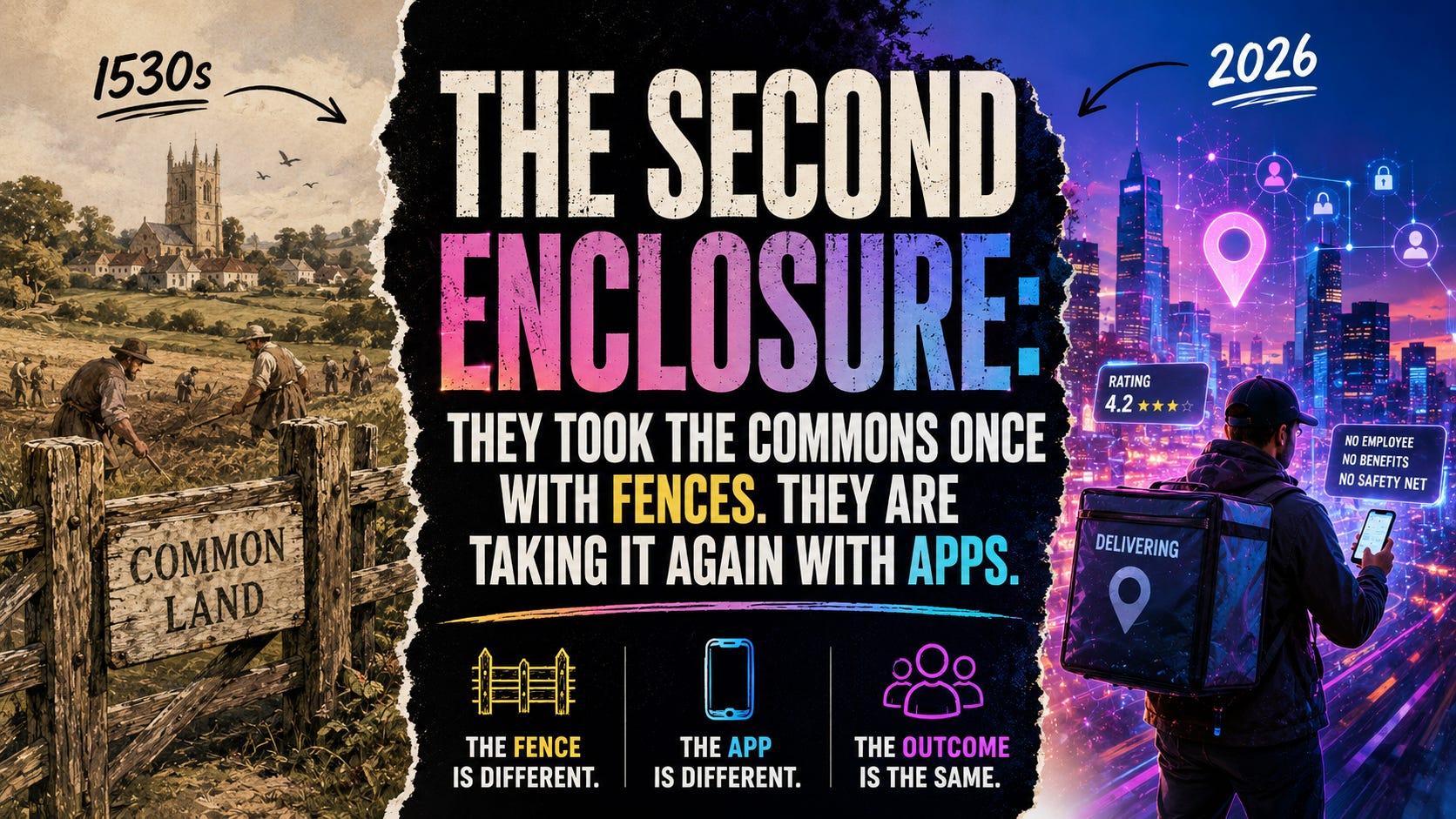
Five hundred years ago, a law converted shared land into private property and left millions of workers with nothing to fall back on. In 2026, a terms of service agreement is doing the same thing. Different document. Same outcome.
Power and Institutions · Issue 34 · PRECEDENT
A delivery rider in Mumbai earns 12,000 rupees a month, which is roughly $145. He works ten hours a day, six days a week. He has no sick pay. No pension. No minimum wage guarantee. If his rating drops below 4.2 stars, the app deactivates him. No warning. No appeal. No explanation.
He is not an employee of the company whose uniform he wears. He is, legally, an independent contractor providing a service to a platform. This classification means he has no employment relationship with anyone. He cannot unionize. He cannot sue for wrongful termination. He cannot access the labor protections that exist for almost every other category of worker in his country.
This arrangement was invented by lawyers in Silicon Valley in 2009. But the mechanism behind it is 500 years old. And the last time it was used at this scale, it emptied villages across England and created the modern working class.
🎯 What this article gives you
By the end of this, you’ll know:
→ What the commons was and why its destruction created a workforce that could not refuse
→ Why legal reclassification, not physical force, is how power eliminates worker alternatives
→ The specific mechanism connecting the 1500s enclosure movement to the 2026 gig economy
→ What 12 million gig workers in India did on Republic Day 2026 and what happened next
→ The one country that rebuilt the floor the enclosure movement destroyed, and what that looks like in practice
→ What the ILO is building in Geneva right now and whether it will work
This article is the companion to The Black Death Gave Labor the Only Power It Ever Had. AI Is Taking It Back. That article documented how labor got power through scarcity and how AI is reversing it. This article documents how workers lost the institutional floor that protected them between 1347 and 2026, and how that floor is being rebuilt.
📍 Start here: what the commons actually was
Before we talk about what was lost, we need to understand what it was.
The commons was not empty land. It was a shared system of use-rights that gave ordinary people an economic position that did not depend on any single employer.
A peasant family in 15th-century England could graze cattle on common land, cut peat for fuel, gather wood for heating, glean leftover grain after harvest, and fish from shared waterways. None of this made them wealthy. Together, it meant they had enough to survive without accepting the first wage offer presented to them.
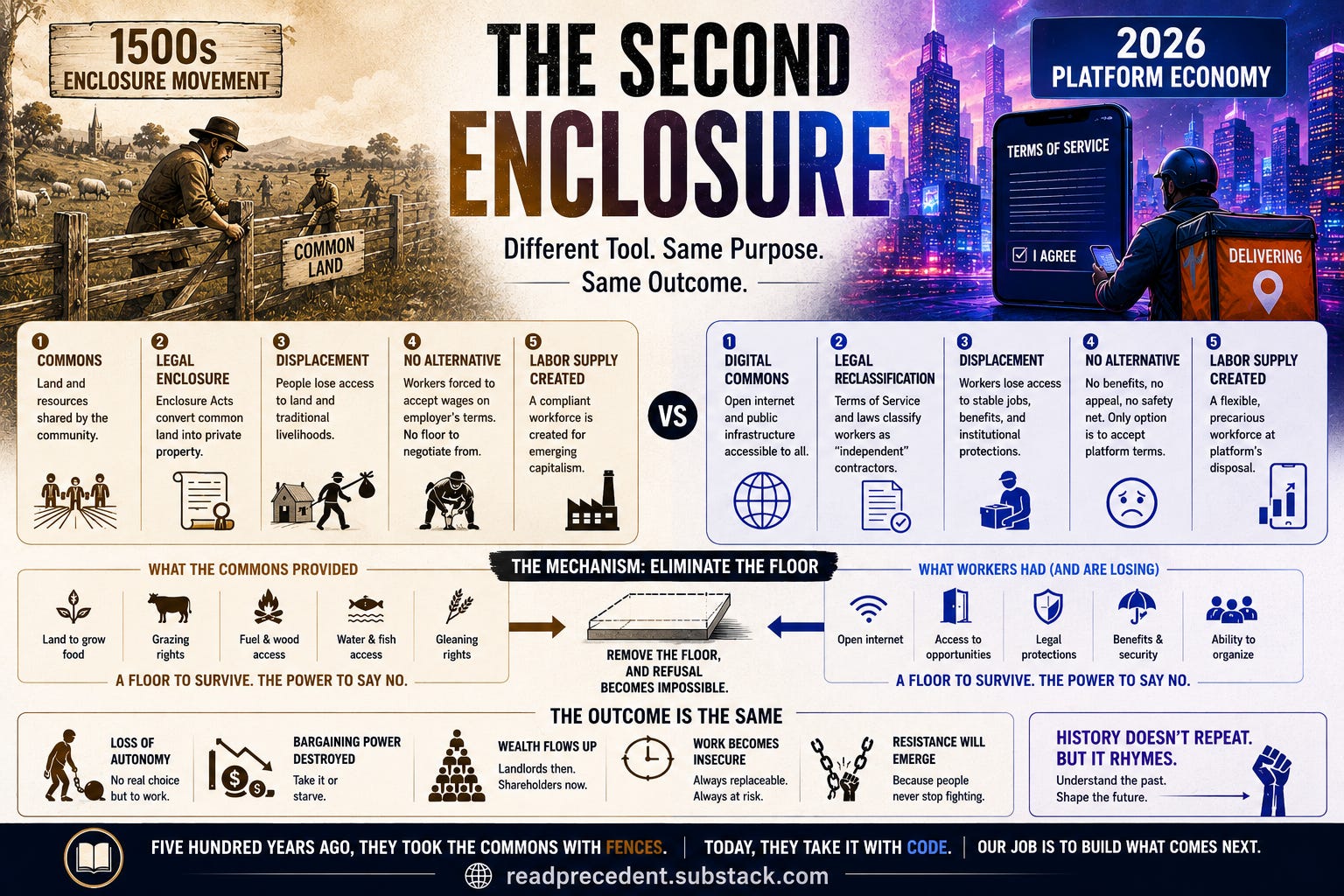
This is the key insight: the commons was not charity. It was a floor.
When you have a floor, you can negotiate. You can walk away from a bad deal because the alternative is not starvation. You can refuse the exploitative employer and survive on what the commons provides while you wait for something better.
The power dynamic shifts completely when you remove the floor. Without the commons, the peasant’s only option was to accept whatever terms the landlord offered. Because the alternative was nothing.
This is why the enclosure movement mattered. And this is why the gig economy’s legal architecture matters today.
⚖️ The two enclosures
The First Enclosure: 1530 to 1850, England
Between 1530 and 1850, the English Parliament passed a series of Enclosure Acts that converted common land into private property. Roughly 6.8 million acres of shared land were enclosed in this period.
The legal mechanism was precise. A commission was appointed. The common land was surveyed. New ownership boundaries were drawn. Customary use-rights that had existed for generations were extinguished overnight. Former commoners received small allotment plots as compensation. The plots were real. They were just too small to live on without also working for wages.
The displaced commoner did not lose their right to eat. They lost their right to refuse. Without the commons, they had no floor. They worked on whatever terms were offered because the only alternative was destitution.
In 1516, a writer named Thomas More watched this happening from his window in London and described it with the most memorable line ever written about economic dispossession: “Your sheep, that were wont to be so meek and tame, now be become so great devourers and so wild, that they eat up, and swallow down, the very men themselves.”
He was not speaking metaphorically. Landlords were converting arable common fields to sheep pasture because wool was more profitable than grain. The conversion required clearing the people who worked and lived on those fields. The sheep ate the land. The land ate the people.
“The enclosure movement did not make land more productive. It made workers more compliant. The fence was not an agricultural instrument. It was a labor policy.”
The Second Enclosure: 2009 to 2026, global
In 2009, Uber launched in San Francisco. By 2026, the platform economy it pioneered employs an estimated 400 million workers worldwide in arrangements that share one structural feature with the English enclosure movement: the systematic elimination of the institutional floor that makes refusal possible.
The instrument is not a Parliamentary Act. It is a Terms of Service agreement. The mechanism is not land conversion. It is employment reclassification. The outcome is the same: a workforce with no floor, negotiating against a platform with total information advantage over their ratings, their routes, their income history, and their access to future work.
In May 2026, Human Rights Watch published a report documenting gig workers across nine countries: India, Kenya, Kuwait, Lebanon, Mexico, Pakistan, Saudi Arabia, the United Arab Emirates, and the United Kingdom. The finding that captured the most attention was the simplest: in country after country, workers reported they had no access to toilets during their working hours.
The toilet is not a symbol. It is a legal indicator. A worker who cannot access a toilet during their shift has no employment relationship with any entity that could be required to provide one. They are not, legally, at work. They are providing a service. The gap between those two sentences is where 400 million people live.
📊 The mechanism: how legal reclassification eliminates the floor
The critical insight that connects the first enclosure to the second is that neither used physical force as the primary instrument.
The first enclosure used law. A Parliamentary Act converted customary use-rights into trespass. The peasant did not lose access to the commons because someone physically stopped them. They lost it because using the land they had always used became a crime overnight.
The second enclosure uses contract law. A Terms of Service agreement converts an employment relationship into an independent contractor arrangement. The gig worker does not lose access to labor protections because someone physically removed them. They lose it because the legal category they are placed in, “independent contractor,” excludes them from every protection that exists for the category they were previously in, “employee.”
The platform economy is remarkable for confirming a pattern that the Hungarian economist Karl Polanyi identified in 1944. Writing about the industrial revolution in The Great Transformation, Polanyi argued that markets do not naturally expand. They are deliberately expanded by state and legal action that converts previously non-market goods into commodities available for trade.
Land was the first conversion. The enclosure movement converted land from a social system of shared use into a market commodity that could be bought, sold, and enclosed.
Labor was the second conversion. The factory system converted labor from a social relationship embedded in community and custom into a market commodity sold by the hour.
Data is the third conversion. The platform economy is converting the digital traces of human activity, routes driven, goods delivered, ratings received, hours worked, into platform-owned assets that the worker generates and the platform keeps.
Polanyi also predicted the response. He called it the “double movement”: every expansion of market reach produces a counter-movement of social self-protection. The Factory Acts of the 1830s responded to industrial labor commodification. The welfare state responded to market volatility. The ILO Convention being negotiated in Geneva right now is the response to platform labor commodification.
“Polanyi said every market expansion produces a counter-movement. The Factory Acts were the counter-movement to the industrial revolution. The ILO Platform Work Convention is the counter-movement to the gig economy. The distance between a Parliamentary Act and a binding labor standard is usually about 50 years. The platform economy is 17 years old. The counter-movement is running slightly ahead of schedule.”
India: 12 million workers, a Republic Day strike, and a 90 day threshold
India has the largest gig workforce in the world by absolute count. Gig workers in India increased to 12 million in fiscal year 2025, up from 7.7 million in fiscal year 2021, a growth of 55 percent.
About 40 percent of these workers earn below 15,000 rupees per month, which is below subsistence level in any of India’s major cities. Platform algorithms control which workers get which jobs, how their performance is monitored, how their wages are calculated, and when they are deactivated.
In late December 2025 and early January 2026, something happened that the official narrative of gig economy growth had not anticipated. Delivery riders and gig workers across Zomato, Swiggy, Blinkit, and several other major platforms organized the largest labor action in India’s modern gig economy. The Gig and Platform Service Workers Union called for a nationwide strike on January 26, 2026.
January 26 is Republic Day. The day India celebrates its constitution. The choice of date was deliberate. India’s constitution guarantees rights. The gig workers were asking whether those rights apply to them.
The strikes generated media coverage and some platform concessions in specific cities. At the national level, the government responded by releasing draft rules under the Social Security Code of 2020.
The Code had formally recognized gig and platform workers as a legal category in 2020. That recognition mattered. It was the first time Indian law acknowledged these workers existed. But the draft rules released in January 2026 specified that to qualify for social security benefits, a gig worker must be engaged with a single aggregator for at least 90 days in a financial year. For workers using multiple platforms, the threshold rises to 120 days.
This is the allotment plot. It is large enough to acknowledge the right. It is structured precisely to ensure that the most economically precarious workers, those who move between platforms irregularly because their income depends on taking work wherever it appears, will never accumulate enough qualifying days to receive benefits.
The workers who most need the protection are exactly the workers the threshold excludes.
This pattern, the legal form that acknowledges and the operational design that excludes, is the enclosure movement’s parliamentary allotment reproduced in 21st-century regulatory language. The peasant received an allotment. The gig worker receives a threshold. The allotment was too small for subsistence. The threshold is too high for the precarious.
“India’s gig workers went on strike on Republic Day 2026 because the constitution guarantees rights and they do not have them. The government responded with a Social Security Code that recognized their existence and a 90-day threshold that ensured the most precarious workers would not qualify for the benefits recognition promised. This is not new policy design. It is the Parliamentary Enclosure Act’s allotment plot, written in digital-age regulatory language.”
🌍 The ILO Convention: Geneva, 2025 to 2026
After years of organizing by workers, unions, and advocacy organizations across 187 countries, the International Labour Organisation agreed in June 2025 at its 113th International Labour Conference in Geneva, Switzerland, to establish binding labor standards for the platform economy. A Convention and a Recommendation are expected to be adopted at the 2026 ILC.
This is the most significant labor institution-building moment since the US Wagner Act of 1935, which established the legal framework for collective bargaining and remains the foundation of American labor law.
The Convention being drafted covers four core areas. The right to know the criteria by which the algorithm rates and deactivates workers. The right to human review of algorithmic decisions. Minimum income protections regardless of employment classification. The right to organize regardless of contractor status.
These four rights are the institutional equivalent of the Factory Acts of the 1830s. The Factory Acts did not solve the industrial revolution’s labor problem immediately. They established the legal framework within which labor’s position could improve over the following century. The ILO Platform Work Convention is attempting to do the same thing for the platform economy.
The enforcement gap is real and acknowledged by everyone working on the Convention. An ILO Convention is binding only on states that ratify it. The platform companies whose business models depend on contractor classification are headquartered primarily in the United States, which has ratified fewer ILO Conventions than almost any other major economy, and the European Union, which is implementing the EU Platform Work Directive with varying ambition across its member states.
The platform labor itself is concentrated in India, Kenya, Indonesia, Brazil, the Philippines, and Pakistan. The labor standards will need to travel through the domestic legal systems of these countries, each of which is also trying to attract platform investment. The Convention sets the standard. Ratification translates it to law. Implementation enforces it. The distance between those three stages is where workers wait.
Denmark: the counter-case that shows what rebuilding the floor looks like
Denmark has a smaller gig economy than India, or Brazil, or the United States, proportionally. This is not an accident.
Denmark’s Flexicurity model, developed through agreements between government, employers’ associations, and trade unions across the 1990s and 2000s, gives workers three things simultaneously. Flexible hiring and firing rules that allow companies to adjust their workforce without prohibitive legal barriers. Generous unemployment benefits covering up to 90 percent of previous wages for the first period of unemployment. Active labor market support including funded retraining, placement assistance, and skills development during the unemployment period.
The combined effect is a floor independent of any single employer. A Danish gig worker who is deactivated by an algorithm does not face the same situation as a Mumbai delivery rider who is deactivated. The Danish worker has a guaranteed income floor, active support finding alternative work, and the institutional backing of a union that represents self-employed workers as well as employees.
When workers have a survivable floor, deactivation is a setback. When workers have no floor, deactivation is a catastrophe. The difference between those two situations is what determines whether a worker can negotiate or must accept.
Denmark’s gig sector is smaller because workers with a floor do not need to accept gig conditions. Platforms that can only attract workers by offering better conditions than the floor provide better conditions. Platforms that can attract workers by being the only alternative to destitution do not.
This is the commons rebuilt. Not as common land. As social insurance architecture. The form is different. The structural function is identical: it gives workers an alternative, and alternatives create leverage.
The Danish model is expensive and took decades to build through sustained political will and institutional trust between labor and capital that cannot be imported overnight. But the principle it embodies is the principle that works everywhere the historical record has been tested: the only sustainable protection for workers is a floor that does not belong to any single employer.
The floor is the commons. The enclosure movement destroyed it. Denmark rebuilt it. The question the ILO Convention must answer is whether the rest of the world follows.
How the Shock Travels
The gig economy shock and the AI white-collar shock documented in Your Company Is Blaming AI for Your Layoff. The Real Cause Is $103 Oil. are the same mechanism operating at two different levels of the labor market.
At the gig level, the shock arrives as algorithmic deactivation. No warning, no appeal, no explanation. One day the app works. The next day it does not. The worker has no institutional relationship with any party that requires them to justify the decision.
At the white-collar level, the shock arrives as a transformation initiative press release. “We are restructuring our workforce to leverage AI capabilities.” The language is corporate. The mechanism is the same: legal reclassification of the work relationship, appropriation of the accumulated institutional knowledge the worker built, replacement with a technology that performs a version of the same function at lower cost.
Both shocks trace to the same root question that the enclosure movement raised in 1530 and that has not been fully answered since: who owns the floor?
The peasant who lost the commons lost access to a resource their labor had helped maintain for generations. The gig worker who loses the platform loses access to a customer base and a rating history their labor built. The junior analyst whose role is eliminated after training an AI system loses access to the institutional knowledge their work generated.
In each case, the labor built something. In each case, the legal framework ensured that something belonged to the entity, the landlord, the platform, the corporation, with the power to write the terms.
This is what the Molt, documented in The Molt on this publication, looks like at the individual level. The institution converts the worker’s contribution into its own next form. The contribution disappears into the platform’s rating system, the company’s training data, the landlord’s sheep pasture. The worker starts over with nothing.
The Human Layer
The specific human being at the center of the second enclosure is not a technology executive or a labor lawyer.
She is a woman in Nairobi named Grace, who delivers food for a major platform app six days a week and has a rating of 4.6 stars. She does not know what would happen if that rating dropped to 4.2. The platform’s algorithm has never explained its deactivation criteria to her. She has asked. There is no one to ask.
She is a man in Jakarta named Budi, who drives for a ride-hailing platform and cannot afford to take a day off when he is sick because he has no sick pay and no savings buffer because income volatility means he cannot save.
She is a domestic worker in Kuwait named Maria, who came from the Philippines on a contract that was different from what she was promised, who works for a family she cannot leave because her visa is tied to her employer, and whose situation Human Rights Watch documented in their May 2026 report as one of the most severe forms of the platform labor condition.
These three workers are not in the same legal situation. But they share one structural characteristic: they have no floor. The absence of the floor is what connects the delivery rider in Mumbai, the driver in Jakarta, the domestic worker in Kuwait, and the displaced junior analyst in Chicago. They are all operating in a labor market where the legal architecture has been arranged to eliminate the institutional position that gives workers the ability to negotiate.
The commons is gone. The allotment is too small. The threshold is too high. The Convention is still being negotiated.
In the meantime, Grace checks her rating every morning.
🎯 The pattern
The enclosure movement, the industrial revolution, and the platform economy are not three separate economic events. They are three phases of the same process that Polanyi identified in 1944: the deliberate expansion of market reach into social relationships that were previously protected by non-market institutions.
Phase 1: The commons. Shared land converted to private property. The peasant’s floor eliminated. The wage-dependent working class created.
Phase 2: Employment law. The Factory Acts, the Wagner Act, the welfare state. The floor rebuilt through institutional design. The wage-dependent worker given protections that made their position survivable.
Phase 3: The platform economy. Employment relationships converted to contractor arrangements. The institutional floor eliminated again, through legal reclassification rather than land conversion. The gig worker left in the same structural position as the post-enclosure peasant.
Phase 4: The counter-movement. The ILO Platform Work Convention. India’s Social Security Code. The EU Platform Work Directive. Denmark’s flexicurity. The institutional response that always follows the market expansion, if the counter-movement is built fast enough.
The pattern has one variable: whether the counter-movement builds the floor fast enough, and builds it in a form that the next round of reclassification cannot eliminate.
The guild that Issue 33 of this series identified as the instrument that makes labor’s leverage permanent is not a craft association. It is whatever institutional structure successfully rebuilds the floor. The medieval guild did it through quality standards and apprenticeship regulation. The 20th-century union did it through collective bargaining and political representation. The 21st-century equivalent will need to do it in a way that survives contractor reclassification.
The ILO is attempting to build that instrument. The question is whether the attempt produces a Wagner Act or an allotment plot.
The answer will determine the conditions of work for 400 million people. And it will be decided in Geneva, in Delhi, in Brussels, and in the app queues of delivery riders in nine countries who have never heard of Karl Polanyi but are living in the economic system he spent his life trying to explain.
“The fence is different. The app is different. The outcome is the same: no floor, no refusal, no leverage. The delivery rider in Mumbai and the displaced peasant in 16th-century England never met. They share the same structural position.”
📚 References
Karl Polanyi, The Great Transformation: The Political and Economic Origins of Our Time, Farrar and Rinehart, 1944 (Beacon Press, 2001) — foundational framework for the commodification of labor and the double movement counter-response
James Boyle, “The Second Enclosure Movement and the Construction of the Public Domain,” Law and Contemporary Problems, Vol. 66, No. 1-2, 2003, pp. 33-74, Duke Law School — originating academic articulation of data appropriation as second enclosure
Martin Kenney, John Zysman, and Dafna Bearson, “Transformation or Structural Change? What Polanyi Can Teach Us About the Platform Economy,” Sociologica, Vol. 15, No. 1, 2021 — the platform as the factory of the digital era, Polanyi framework applied to platform capitalism
Gernot Grabher and Jonas König, “Disruption, Embedded: A Polanyian Framing of the Platform Economy,” Sociologica, Vol. 14, No. 1, 2020 — second enclosure as data appropriation mechanism
Nick Srnicek, Platform Capitalism, Polity Press, 2017 — structural account of platform business models and their relationship to labor
Human Rights Watch, “Algorithms of Exploitation: Rights Abuses in the Gig Economy and the Global Fight for Change,” May 13, 2026 — nine-country primary documentation of gig worker conditions: India, Kenya, Kuwait, Lebanon, Mexico, Pakistan, Saudi Arabia, UAE, UK
Human Rights Watch, “The Gig Trap: Algorithmic, Wage and Labor Exploitation in Platform Work in the US,” June 24, 2025 — independent contractor classification mechanism and collective bargaining denial
Transnational Institute, “Platform Power and the Future of Work,” August 1, 2025 — ILO 113th International Labour Conference June 2025, Convention and Recommendation framework
India Economic Survey 2025-26, Ministry of Finance, tabled January 29, 2026 — 12 million gig workers, 40 percent below 15,000 rupees monthly, algorithmic management concerns
Drishti IAS editorial based on The Hindu, “Gig Economy: Balancing Growth with Worker Protection,” January 2, 2026 — Social Security Code 2020, Draft Rules January 2026, 90-day threshold
Countercurrents, “Gig and Platform Service Workers Union calls for nationwide online strike on 26 January 2026,” January 26, 2026 — GIPSWU strike announcement and demands
Thomas More, Utopia, 1516 (Cambridge University Press critical edition, 2002, ed. George M. Logan and Robert M. Adams) — the sheep-devouring-men passage, primary source
Robert C. Allen, Enclosure and the Yeoman: The Agricultural Development of the South Midlands, 1450-1850, Clarendon Press, 1992 — the 6.8 million acres figure, the allotment compensation mechanism
E.P. Thompson, Customs in Common: Studies in Traditional Popular Culture, Merlin Press, 1991 — the commons as complex shared-use system, the detailed record of customary rights extinguished by enclosure
IBE Copenhagen, “Flexicurity in Denmark,” 2023 — three components of the Danish model, the floor mechanism, the tripartite agreement structure
PRECEDENT, The Black Death Gave Labor the Only Power It Ever Had. AI Is Taking It Back. — the 675-year sequence
PRECEDENT, Your Company Is Blaming AI for Your Layoff. The Real Cause Is $103 Oil. the Hormuz-to-pink-slip transmission
PRECEDENT, The Molt — dominant institutions converting workforce into capital for their next form
PRECEDENT, The Wage That Changed the Household — wartime labor restructuring at household level
If this changed how you see your delivery app, subscribe. If it didn’t, tell me why. I read everything.